|






|

The
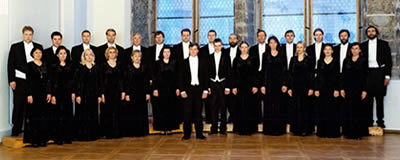
Estonian Philharmonic Chamber Choir
Artistic Director Kaspars Putniņš
February 9 – 21, 2017
Choir of 28
A sold-out Carnegie Hall classical choral
concert doesn’t happen every day, but when the Estonian choir came to
town last June, they created just that. It was a culmination of sorts
for these regular visitors to the most prestigious stages in the U.S.
and Europe. Now they return for their 10th tour to perform
Tchaikovsky’s Vespers and more from northern Europe, with
newly-named artistic director Kaspars Putnins conducting. Mr. Putnins
has led choral concets at Lincoln Centre, the Concertgebouw of
Amsterdam, Berliner Philharmonie and Konzerthaus, Cité de la musique in
Paris, Berwaldhallen in Stockholm, Dresdner Frauenkirche etc.
"so wondrously talented a group of
singers… The selections and the performances were so fine that they left
you feeling like an ingrate, greedily hungry for more." The New
York Times
|

Music
In MP3 Format
Arvo Pärt Salve Regina from
Harmonia Mundi CD 907730
(Opens with most MP3 players, including Quicktime which you can download
for free)
Publicity
Photos
|
|

Biography
The Estonian
Philharmonic Chamber Choir (EPCC) is one of the best-known choirs in the
world. The EPCC was founded by Tõnu Kaljuste in 1981, who was the artistic
director and chief conductor for twenty years. In 2001–2007, the English
musician Paul Hillier took over; between the years 2008–2013 the artistic
director and chief conductor was Daniel Reuss. In the fall of 2014, Latvian
Kaspars Putnins assumes the title of Artistic Director.
The repertoire of
the choir extends from Gregorian chant and baroque to the music of the 21th
century, ever special focus on the work of Estonian composers (Arvo Pärt, Veljo
Tormis, Erkki-Sven Tüür, Galina Grigoryeva, Toivo Tulev, Tõnu Kõrvits, Helena
Tulve) and introducing it to the world. Each season the choir gives about 60–70
concerts in Estonia and abroad.
The EPCC has
cooperated with a number of outstanding conductors and orchestras – Claudio
Abbado, Helmuth Rilling, Eric Ericson, Ward Swingle, Neeme Järvi, Paavo Järvi,
Nikolai Alekseyev, Olari Elts, Andrew Lawrence-King, Roland Böer, Frieder
Bernius, Stephen Layton, Marc Minkowski, Christoph Poppen, Sir Colin Davis,
Louis Langree, Paul McCreesh; with Norwegian, Australian, Lithuanian, Prague and
Stuttgardt Chamber Orchestras, London Symphony Orchestra, Mahler Chamber
Orchestra, Berlin Rundfunk Orchestra, Concerto Copenhagen, Concerto Palatino,
Salzburg Camerata, Les Musiciens du Louvre-Grenoble, London Symphony Orchestra,
Basel Chamber Orchestra and with Estonian National Symphony Orchestra and
Tallinn Chamber Orchestra.
The EPCC has been a
welcome guest at numerous music festivals and outstanding venues all over the
world, for instance at BBC Proms, Mozartwoche, Abu Gosh Music Festival, Hong
Kong Arts Festival, Moscow Easter Festival, Musikfest Bremen, Salzburg
Festspiele, Edinburgh International Festival, Festival Aix-en-Provence,
International Cervantino Festival, Vale of Glamorgan, Bergen International
Festival, Schleswig-Holstein Musik Festival, Sydney Opera House, Wiener
Konzerthaus, Amsterdam Concertgebouw, Lincoln Center in New York etc.
Another important
aspect in the choir’s life is recording music (for ECM, Virgin Classics, Carus,
Harmonia Mundi, Ondine), resulting in award-winning CDs. EPCC recordings have
won twice GRAMMY-Award for Best Choral Performance: in 2007 for the album
Arvo Pärt. Da Pacem (conductor Paul Hillier, Harmonia Mundi) and in 2014
Arvo Pärt. Adam’s Lament (conductor Tõnu Kaljuste, ECM). All in all, the
choir has 14 Grammy nominations with the works by Arvo Pärt, Erkki-Sven Tüür and
the music of Nordic countries. The EPCC recordings have won also the award
Diapason d’or, Preis der Deutschen Schallplattenkritik, Danish Music Award etc.
Kaspars Putniņš
(1966) is a choir conductor, and producer well known internationally. Conductor
of the Latvian Radio Choir since 1992. In 1994, he initiated the Latvian Radio
Chamber Singers – an ensemble of soloists, the members of Latvian Radio Choir.
The Chamber Singers works as an innovative musical and sonic laboratory
for the choir itself: it has greatly contributed to the unique international
fame of the Latvian Radio Choir. The projects initiated by Putniņš’ have
involved frequent and fruitful collaboration with the artists representing drama
and visual arts. His ideas have been developed into multimedia shows like
Black Over Red and The Book of Your Silence (both with Scotland
Theatre Cryptic), the electro-acoustic forest walk The Tale of
Kurbads, Press to Play a. o. Kaspars Putniņš and his colleagues are
especially interested in the modern polyphonic vocal music, electro-acoustic
music and novel vocal techniques. A number of composers have written new
compositions encouraged by him – among them Gavin Bryars, Maija Einfelde, Karin
Rehnqvist, Toivo Tulev, Lasse Thoresen and Mārtiņš Viļums among many others. He
regularly appears as a guest conductor with leading European choirs such as the
BBC Singers, RIAS Kammerchor, Netherlands Chamber Choir, Swedish Radio Choir,
Netherlands Radio Choir, Flemish Radio Choir and others.
Kaspars Putniņš
graduated from the Vītols Latvian Academy of Music and the Guildhall School
of Music and Drama, London. He is busy lecturing and frequently is engaged
as a member of international juries. Putniņš is the recipient of the Latvian
Grand Music Award and the Award of the Cabinet of Ministers of Latvia for
Achievement in Culture and Science. He has conducted at Lincoln Center in New
York, Muziekgebouw of Amsterdam, Berliner Philharmonie and Konzerthaus, Cité de
la musique in Paris, Berwaldhallen in Stockholm, Dresdner Frauenkirche etc.
Reviews
|

CLICK to read:
 |
|

An Affirmation of Faith at Carnegie Hall
Diverse Disciples Flock to an Arvo Pärt Tribute
By CORINNA da FONSECA-WOLLHEIM JUNE 3, 2014
Photo Tonu Kaljuste conducting two Estonian
ensembles on Saturday evening at Carnegie Hall. Credit Hiroyuki Ito for The New
York Times
 Orthodox
priests in black robes and conical caps rubbed shoulders with pop stars and
actors, including Björk, Antony Hegarty and Keanu Reeves, at Carnegie Hall on
Saturday at a sold-out concert of music by Arvo Pärt. No other living composer
has so fervent a following or such a diverse group of fans. When Mr. Pärt,
bearded, frail and smiling shyly, took a bow at the end of the evening — this
was his first visit to New York in 30 years — the roar that greeted him seemed
unanimous. Orthodox
priests in black robes and conical caps rubbed shoulders with pop stars and
actors, including Björk, Antony Hegarty and Keanu Reeves, at Carnegie Hall on
Saturday at a sold-out concert of music by Arvo Pärt. No other living composer
has so fervent a following or such a diverse group of fans. When Mr. Pärt,
bearded, frail and smiling shyly, took a bow at the end of the evening — this
was his first visit to New York in 30 years — the roar that greeted him seemed
unanimous.
What is it about Mr. Pärt’s quiet, austere
compositions that stirs such passions? It’s a question at the heart of the Arvo
Pärt Project at St. Vladimir’s Orthodox Theological Seminary in Yonkers, which
painstakingly prepared a current series of concerts devoted to the composer and
panel discussions on the Eastern Orthodox spiritual traditions that feed his
music. The focus of Saturday’s concert was the sacred choral works with which
this Estonian composer, now 78, has affirmed that faith in recent years. But a
meditative quality suffuses even his purely instrumental works.
The evening opened with two early examples of
these from “Tabula Rasa,” the 1984 ECM recording that brought Mr. Pärt
international fame: the lightly pulsating “Fratres,” in a version for violin,
string orchestra and percussion, with Harry Traksmann ably performing the solo
part, and the elegiac “Cantus in Memory of Benjamin Britten.” The Tallinn
Chamber Orchestra, conducted with authority and grace by Tonu Kaljuste, brought
out the clarity of the harmonic progressions in these deceptively simple pieces,
as well as the gradual buildup of sonic texture and emotional weight that makes
them so riveting.
The first-rate Estonian Philharmonic Chamber Choir
joined the orchestra for the remainder of the program. Their performance of
“Adam’s Lament” was emotionally devastating, traversing expressions of grief,
bitter anger and hope. In “Salve Regina,” a celesta joined the choir and string
orchestra, adding a touch of radiance to what is otherwise a private, almost
reticent affirmation of faith.
For the Te Deum, the choir divided into three
spatially separated groups, and a wind harp and a piano lent atmospheric touches
to the orchestration. Mr. Pärt’s setting of the liturgy is strikingly different
from the brilliant Te Deums of previous centuries, in which the glorification of
God is confidently expected to reflect back on the performer and patron. Here,
reverence is expressed as a gentle, devotional ritual, its methodically layered
harmonies resembling the act of applying tiny flakes of gold leaf to a Madonna.
A version of this review appears in print on June
4, 2014, on page C5 of the New York edition with the headline: An Affirmation of
Faith at Carnegie Hall.
#############################
Into the Sanctum With a Master of Awe and Mysticism
Arvo Pärt’s ‘Kanon Pokajanen,’ at the Met
By VIVIEN SCHWEITZERJUNE 3, 2014

Estonian Philharmonic Chamber Choir Robust sound and plaintive whispers: The
choir performing Arvo Pärt’s “Kanon Pokajanen” on Monday evening in the Temple
of Dendur at the Metropolitan Museum of Art. Credit Hiroyuki Ito for The New
York Times
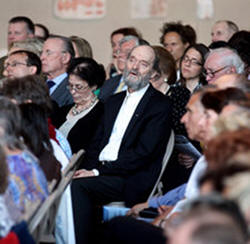 Arvo
Pärt at the concert at the Metropolitan Museum of Art. Credit Hiroyuki Ito for
The New York Times Arvo
Pärt at the concert at the Metropolitan Museum of Art. Credit Hiroyuki Ito for
The New York Times
Composers are inspired by myriad sources,
including a particular event, emotion, person or landscape. The prime
inspiration of the Estonian composer Arvo Pärt, however, was suppressed for a
long stretch of his career. Beginning in the 1960s, Mr. Pärt, a convert to the
Eastern Orthodox faith, wrote works whose religious character irked the Soviet
authorities at a time when the official credo was atheism.
Religion and composition have been intertwined
throughout Mr. Pärt’s career, a synthesis that is being explored by the series
of Arvo Pärt Project concerts. The composer attended an alluring performance of
his “Kanon Pokajanen” (“Canon of Repentance”) on Monday evening at the Temple of
Dendur in the Metropolitan Museum, streamed live by the Met and broadcast live
on WQXR.
The Kanon was commissioned to commemorate the
750th anniversary of Cologne Cathedral and received its premiere there in 1998,
performed by the Estonian Philharmonic Chamber Choir under the direction of Tonu
Kaljuste, who also led the choir here. Written almost exclusively in D minor and
sung in Church Slavonic, the music is set to the text of an Orthodox hymn called
the “Canon of Repentance to Our Lord Jesus Christ.”
The work incorporates Mr. Pärt’s signature
technique of tintinnabuli, named for the Latin word for bells and developed from
Renaissance polyphony and Gregorian and Russian chant.
The singers sat in a circle, rendering the work
with a power and purity of tone that fully revealed its mystical, serene
qualities. Throughout, the choir vividly illuminated the various choral timbres
of the piece, which range from the robust, full choral sound of the opening to
plaintive interludes featuring the resonant low male voices or the whisper of
the upper voices alone. During one section the sopranos soared over a rumbling
bass pedal point; in another, high dissonant harmonies proved striking.
The audience responded with a standing ovation as
Mr. Pärt took his bows with the musicians.
A version of this review appears in print on June 4, 2014, on page C5 of the New
York edition with the headline: Into the Sanctum With a Master of Awe and
Mysticism.
|
|
Washington Post May 30, 2014
Arvo Pärt provides intimate performance of his
minimalist music at Phillips Collection
By Stephen Brookes, Published: May 30
E-mail the writer
The remarkable Estonian composer Arvo Pärt — whose
spare and almost mystical music has been embraced by an audience far beyond the
usual classical circles — has had a triumphant run in Washington this week.
After a hugely successful concert of orchestral and choral works at the Kennedy
Center on Tuesday, Pärt returned on Thursday to the Phillips Collection for a
more intimate performance of his chamber music — nearly a dozen works that,
despite their modest size, seemed to evoke the same aura of quiet majesty, the
same sense of austere spirituality, and the same purity of expression as his
large-scale music.
That’s no easy task. But as the evening unfolded —
sketching an arc from the pathbreaking “Für Alina” from 1976, to the premiere of
his newest work, “My Heart’s in the Highlands” — it was clear that Pärt’s music
thrives on being pared to its essentials, becoming all the more powerful for it.
Pärt is often labeled (by admirers and detractors alike) as a “holy minimalist,”
but it’s an apt title. In “Für Alina,” for example, he built a sense of
limitless, light-filled space with only the simplest of musical materials, and
in every work on the program he seemed to find a universe in even the smallest
grain of musical sand.
That held true throughout the evening, from the tender “Variations for the
Healing of Arinushka” (in a deeply felt reading by pianist Marrit
Gerretz-Traksmann) to the radiant “Vater unser,” sung by alto Iris Oja. There
were a few familiar works, including “Spiegel im Spiegel” (now so iconic it’s
even been quoted in “The Simpsons”) and “Fratres” (heard here for violin and
piano, in contrast to the orchestral version at the Kennedy Center), but
less-familiar pieces such as “Mozart-Adagio” — a stunning arrangement of the
second movement of Mozart’s piano sonata in F Major, K. 280 — and the relatively
dark and dissonant “Es sang vor langen jahren,” showed off aspects of Pärt’s
musical personality that only deepened the interest of his music.
Brookes is a freelance writer.
|
|

Richard Termine for The New York Times
The Estonian Philharmonic Chamber Choir flanking the
majestic organ at the Church of St. Ignatius Loyola.
Music Review | Estonian Philharmonic Chamber Choir
Folkish Sounds of Estonia, With a Dash of Rachmaninoff
 By JAMES R.
OESTREICH By JAMES R.
OESTREICH
Published: March 21, 2006
The
program was devoted largely to music of Arvo Pärt, and on the strength of it,
you might have wished for more. On the other hand, the mere four numbers from
Rachmaninoff's glorious Vespers whetted the appetite for the whole work. You
might even have wished for more music by Cyrillus Kreek on the basis of his
"Five Religious Folk Songs."
It was that kind of concert, by Paul Hillier and the Estonian
Philharmonic Chamber Choir at the Church of St. Ignatius Loyola on Sunday
afternoon. The selections and the performances were
so fine that they left you feeling like an ingrate, greedily hungry for more.
Happily, more is available on CD's from Harmonia Mundi France, or will be.
Several of the Pärt pieces performed on Sunday here and others are to be
released in September. Mr. Hillier's recording of the complete Rachmaninoff
Vespers appeared last year.
What
is always striking about Mr. Pärt's music is its originality, and that was
especially apparent here in "Dopo la Vittoria" ("After the Complete Victory,"
1997), to a text from Archbishop Philaret's "History of Church Singers and
Chants," of 1902, which tells of the creation of hymns by St. Ambrose and St.
Augustine. Straight, mundane historical narrative is presented in a joyous,
jogging storytelling mode, and the quotations from the hymns themselves soar to
transcendent heights.
Mr.
Pärt's originality was also apparent in two older organ works, deftly played by
Christopher Bowers-Broadbent. "Annum per Annum" (1980), a charming set of
variations, begins with a sustained swooning — ultimately, wheezing —
decrescendo and ends with a briefer opposite: a triumphant swelling statement of
D major.
Remarkably, Rachmaninoff's Vespers, scarcely known in the West a few decades
ago, has become almost standard repertory. Dennis Keene and the Voices of
Ascension gave a superbly polished account of substantial excerpts at the Church
of the Ascension less than a month ago, and the next night Stefan Parkman and
the Academy Chamber Choir of Uppsala, Sweden, presented a grippingly theatrical
performance of the whole work, also at St. Ignatius.
Mr. Hillier's excerpts were just what you might expect from one
of the finest choral conductors of the day with so wondrously talented a
group of singers (27 strong).
Whatever voices were heard individually were of soloist caliber,
and Iris Oja, a mezzo-soprano, was superb in her extended solo, rendered with
earth-motherly warmth.
The
folkish vein of Kreek's Estonian songs carried into an encore by Mart Saar,
another Estonian: "Why Are You Weeping, Oak Tree?
|
|


CLASSICAL MUSIC
Monday, March 20, 2006; C05
Estonian Philharmonic Chamber Choir
Many spent Friday night celebrating real or imagined Irish
heritage, but at the University of Maryland's Clarice Smith Performing Arts
Center, the world-renowned Estonian Philharmonic Chamber Choir turned its
talents toward music from its home country. Under artistic director Paul Hillier
and with organist Christopher Bowers-Broadbent,
the choir's performances inspired a transporting awe, hard to
find no matter where you're from.
The choir did sing some non-Estonian music, specifically excerpts
from Sergei Rachmaninoff's "All-Night Vigil." Those who know Rachmaninoff as Mr.
Big Tune will be surprised by this rapt devotional work of Russian Orthodox
harmonies and complex vocal techniques. The choir
realized every detail of the composer's conception, with perfect blending up and
down the tonal spectrum and the kind of virtuosity that makes everything sound
easy.
These
same virtues shone in the native Estonian works as well: Cyrillus Kreek's
imaginative, loving arrangements of five Estonian religious folk songs, and five
separate choral pieces by Arvo Part, whose spare harmonies and hypnotic textures
have made him Estonia's most famous composer. (Besides providing accompaniment,
organist Bowers-Broadbent also soloed in two intriguing Part works.)
The choir's flawless intonation, pure, thrilling
tone, and careful attention to text and structure brought out the surprising
narrative energy and ebullience of Part's "Dopo la Vittoria," the riveting
dissonances in "Nunc Dimittis" and the harmonic ebb and flow of "Da Pacem Domine."
At the close of the program, as each word rang out clear and urgent in the
breathtakingly intense prayer "Salve Regina," earthly concerns of any kind felt
trivial indeed.
--
Andrew Lindemann Malone
|
|

MUSIC REVIEW
Bringing a master's works to choral life
BY MARION LIGNANA ROSENBERG
SPECIAL TO NEWSDAY
March 22, 2006
The works of Estonian composer Arvo Pärt reach awesome heights and depths of
meaning using the simplest musical means. Like visual artist Mark Rothko, who
drew primal, spiritual energy from mere colored rectangles, Pärt uses the
pared-down language of music -- scales and sometimes single tones -- to
construct art of mesmerizing power.
Sunday's Great Performers concert by the Estonian Philharmonic Chamber Choir
featured five of the master's choral works from the past decade. Pärt's "Salve
Regina" opens with a lilting melody that wafts gracefully downward, moving from
heaven to earth like the Virgin's sweet mercy. High voices intone humanity's
childlike pleas to Mary; the choir's words and sound take on a rapt hush when
Jesus' name is invoked.
Here and throughout the program, conductor Paul Hillier drew from the choir
music-making of sublime and self-abnegating mastery. Faultless in matters of
pitch, dynamics and tonal blend, the choristers never drew attention to their
own virtuosity, instead remaining alert to the sense of wonder in Pärt's
works. Just as his music both exalts and melts away into its mystical texts, so
did the choir sing with soulful, humble beauty.
The audience sat in meditative silence, holding its applause between Pärt's
works. The soft, voluptuous final note in "Littlemore Tractus" - evoking the
"peace at the last" for which believers hope - hovered, vibrant yet immaterial,
in the majestic gold and ochre interior of the Church of St. Ignatius Loyola.
Bouncy, glowing bursts of sound, almost Rossinian in jollity, gladdened the
narrative portions of Pärt's "Dopo la vittoria," a cantata written for the
1,600th anniversary in 1997 of St. Ambrose's death. In the "Anthem of St. John
the Baptist," receiving its New York premiere, the choir evoked a swell of light
as Jesus approached the Baptist and a crushing radiance for the Holy Spirit's
manifestation. The quiet harmonies that opened "Nunc dimittis" first splayed and
then folded in on themselves. A quiet "Amen" brought the canticle to an end,
commingling high tones with the basses' stinging buzz.
Christopher Bowers-Broadbent shone in two solo organ works by Pärt.
"Trivium" sets a single tone (the note D) in a prism, exploring its shifting
colors and implications, in sonorities ranging from whispers to crashing,
grinding swoops. "Annum per annum," a set of variations, is bracketed by an
ear-splitting chord that gradually fades to the faint whirr of the organ
mechanism, only to make the return journey from the hiss of breath to cosmic
vastness at work's end.
In the "Five Religious Folk Songs" by Estonian composer Cyrillus Kreek, the
choir created an uncanny sense of homely, familiar dialogue with the divine.
Selections from Rachmaninoff's "All-Night Vigil" perhaps wanted a grittier
sound, but the choir nonetheless sang with riveting
eloquence, summoning tones of searing, inhuman urgency for the angels'
proclamation of Jesus' resurrection and glory.
Copyright
2006 Newsday Inc.
|
|
December 16, 2005
Surprises and Delicacies in a Year of Exciting Classical CD's
By THE NEW YORK TIMES
The
classical music critics of The New York Times select the year's most notable
CD's.
James R. Oestreich
Rachmaninoff: 'All-Night Vigil'
Estonian Philharmonic Chamber Choir, conducted by Paul Hillier (Harmonia Mundi
France).
Otherwise known as Rachmaninoff's Vespers, for its first section. Everything
Paul Hillier touches turns to choral gold (as used to be the case with Robert
Shaw, who also recorded this glorious work beautifully, late in his career). The
Estonian choir, complete with the requisite Slavic-style deep basses, gives Mr.
Hillier its all.
|
|
Songs of a Modern Allegiance and Reverence
Bernard Holland
New York Times (2003-11-11)
Many countries with small military budgets arm themselves with culture. Art
tells outsiders what a people think and feel; it also provides a rallying ground
and common cause for those within a nation's borders. Never underestimate its
power. Maybe this is why musical visitors from Eastern Europe - in this case the
Estonian Philharmonic Chamber Choir at the Angel Orensanz Foundation on Nov. 5 -
seem to arrive literally brandishing their homegrown creative impulse. Despite a
rainy night and the out-of-the-way location on Norfolk Street on the Lower East
Side, this shabby chic ex-synagogue was nearly full, with an audience split
evenly between the young and the curious, and older people hoping for brief
contact with former homelands. If the music ran from the 17th century to the
present, the Orthodox Church was never out of earshot. Recent pieces like Galina
Grigorjeva's "On Leaving" (mournful, stately), Arvo Pärt's Two Slavonic Psalms
(pushed along by uneven phrases) and Alfred Schnittke's Three Sacred Songs (with
gently subversive inner harmony and changes of key) more or less ignored the
20th-century world of sound around them.
Dmitry Bortniansky, appearing three times on the program, was a
contemporary of Mozart and survived into old age as Mozart did not, dying in
1825. He created a point where Baroque choral style, the operatic tendencies of
the late 18th century and the darkly colored, drone-driven modal style of the
Orthodox Church had little trouble meeting. He was a musician of astonishing
sophistication and one of the few forgotten composers we might think about
remembering.
The Estonians, singing a cappella, were house-proud for their own Mr. Part but
also embraced neighboring music from Russia and Ukraine as well as that of two
18th-century Italian transplants, Baldassare Galuppi and Giuseppe Sarti. The
chorus sang richly, faithfully in tune and with the expected conviction. Under
the British conductor Paul Hillier they were precise without being fanatic about
it. It is a nice sound.
Allegiance to one's national music is two-edged. The underpinning that it
provides is both strength-giving and reassuring. The heavy magnetic field can
also immobilize the imagination. But perhaps I am too American to trust
20th-century composers so abjectly obeisant to their past. A "Gloria" by Vasily
Titov, very beautiful, was also sung.
|
|
Geoff
Chapman
Toronto Star (2003-11-08)
Twenty-seven
mesmerizing voices--and music of sustained beauty that's sustenance for the
soul.
The
vaunted Estonia Philharmonic chamber Choir entranced some hundreds of spectators
last night at Metropolitan United Church, that staunch Methodist bastion on
Queen, with glorious singing that will reverberate in the memories of listeners
for a long time.
The
choir, conducted by English artistic director Paul Hillier (who founded the
Hilliard Ensemble), was performing the first of two concerts under the auspices
of Soundstreams and CBC Radio 2.
The
mostly youthful choristers, whose repertoire also extends to Gregorian chant and
late Baroque, delivered eight works by mostly alive composers from the Baltic
region with focused attention. They sang in English and Latin, as well as their
home language, and this, their third visit to Toronto, may have been their best.
The
shadow of Orthodox Church liturgy was apparent, but the Baltic region has deep
wellsprings of creative art on which to draw, and this choir's concerts and
recordings show that Arvo Part should not be the only regional composer familiar
to western ears.
Hillier's
pinpoint control was evident from Estonian Cyrillus Kreek's "Three Psalms
of David", which made a fine opening. Precisely layered and featuring
deliciously rich resonance in the crucial low registers. It was followed by
(Estonia's) Part, the eloquent simplicity of his "Two Slavic Psalms
tastefully emphasized, its purity never allowed become merely plain.
Perhaps
the second ranking composer from Estonia is VeljoTormis, but his "Kullerva's
Message," drawn from mythic tales of long ago and sung in English was more
novelty than enlightenment.
All
this serious Baltic music allows little interpretive choice and this relatively
frisky, martial piece done with just 16 singers in English was often strident.
It was the weakest point of the evening.
Yet
that's weak compared to the truly glowing elsewhere, such as the succeeding
"Alleluiah" of Lithuania's Algirdas Martinaitis with polyphony so
accomplished it left this scribe in awe.
Russia's
Alfred Schnittke drew on Orthodox liturgy for his "Three Sacred
Songs," the first known to the West as "Ave Maria": the last as
the Lord's Prayer.
Here
refined sensibility was in place, neatly balancing intensity and dignity; and
offering palpable beauty with the bonus of scrupulous diction.
Russian-born
Galina Grigorjeva is now an Estonian, her "On Leaving" featuring a
brooding soulfulness that suited this examination of the moment of death with
poetry and polyphony based on prayer texts.
It
was deeply spiritual, an excellent high tenor soloist most affecting and the
ultra-deep basses fathoming the bleakness of it all.
Denmark's
Per Norgard has found a majestic flow as well as a devilishly complex set of
time signatures for his "Winter Hymn" that was dispatched with a
unique fervour, but it was matched in appeal by the choir's profound reading in
Latin of Estonian composer Urmas Sisask's five-part "Gloria Patri."
The frequent result were passages of serene loveliness.
Tomorrow
night at the same venue at 7:30, the choir, joined by Canada's Elmer Iseler
Singers, will perform a mixed program that includes new Canadian works and the
North American premiere of Henryk Gorecki's epic "Salve Sidus Polinarum."
|
|
From
the Baltics, With Intensity
Daniel Schlosberg
Newsday (2003-11-07)
Just
what, exactly, are they putting in that Baltic Sea? If you've been following the
worldwide classical music scene the past couple of decades, you have to be
asking yourself such a question, as so many renowned musicians hail from the
region. From the idiosyncratic Latvian violinist Gidon Kremer to the intrepid
Finnish conductor Esa-Pekka Salonen, the Baltics seem to be a hotbed of some of
today's most interesting musical activity.
The
Baltics boast particular pride among vocal groups. The Swedish Radio Choir and
the St. Petersburg State Academic Capella (which performed last week) are both at
the top of their genre. So, too, with the Estonian Philharmonic Chamber Choir,
which performed under its illustrious director, Paul Hillier, at the
Orensanz Center on the Lower East Side Wednesday.
The
program of Russian choral music proved to be a soberly intense evening. The
offerings from this specialized repertoire was evenly divided between old and
new, and the most contemporary voices were the most thought provoking. For
example, the longest work of the evening, Galina Grigorjeva's (b. 1962) "On
Leaving," which represents the departure of the soul from the body,
displayed a keen ear for sonorities. Subtle dissonance here and there inflected,
but did not disrupt, a pervasively expansive quality.
And the encore, an "Alleluia" by the Lithuanian Algirdas Martinaitis
(b. 1950), juxtaposed an almost Christmas- carol bounce with undercurrents of
unease. The unresolved ending proved particularly disquieting.
The
18th century was chiefly represented by Dmitry Bortniansky (1751-1825), whose
conservative style (even given the time) effectively emits the sense of
suffering and mystery that is at the heart of so much Russian music. It was also
revealing to hear a work from the classical era by Baldassare Galuppi
(1706-1785). His "In the Flesh Thou Didst Fall Asleep," included some
intricate counterpoint, which the ensemble dispatched with confidence.
Throughout
the evening, the choir sang with control, precision and care. It is not a
group that relishes overt drama, and Hillier favors blend and balance over a
larger emotional palette. Indeed, the most affecting moments were often the most
quiet, where a barely perceptible sound demonstrated the group's magnificent
sense of ensemble. The chorus barely seemed to move, which reinforced the
reserved, grave nature of the music.
Its comportment, as well as its musicality, also underscored the general
aesthetic of Russian Orthodox choral music. As a matter of doctrine, musical
instruments are not allowed inside church doors, and choral singing in the
service assumes a significance on par with prayer. The Estonian Philharmonic
Chamber Chorus distinctly evoked that quality of devotion.
The
gilded, seemingly ageless Orensanz Center, a former synagogue, provided the
perfect backdrop for the meditative and often ravishing performances by this
formidable ensemble.
BALTIC VOICES 2
URMAS SISASK
Five songs from Gloria Patri (1988)
TOIVO TULEV
And then in silence there with me be only You (2002)
PER NORGARD
Winter Hymn (1976/84)
GALINA GRIGORJEVA
On Leaving (1999)
ALFRED SCHNITTKE
Three Sacred Hymns (1983/84)
Estonian Philharmonic Chamber Choir
Paul Hillier
Harmonia Mundi- 907331(CD)
No Reference Recording
No
musical realm is more alive and fertile regarding the production and performance
of new works than that of choral and vocal music. Of course, much of it tends to
be highly imitative/derivative/predictable--mostly for reasons of singability--but
the really interesting new(er) stuff shows that even with the physical
limitations of voices and singing technique, and even within the tonal world,
there's still lots of room for originality. And because so much new choral music
is written and performed every year, choral music fans are some of the most
experienced, adventurous, savvy, and open-minded listeners who, while they
appreciate uniqueness and experimentation, also are intolerant of music that
fails to engage, entertain, move, or otherwise make a discernible point relative
to its particular text choices and musical setting.
In
the second installment of their Baltic Voices series, the Estonian Philharmonic
Chamber Choir and conductor Paul Hillier focus on sacred music from Estonia, the
Ukraine, Denmark, and Russia, all of it written during the past 20 years. Two of
the works--Galina Grigorjeva's On Leaving and Toivo Tulev's And then in silence
there with me be only You--are world-premiere recordings, and the rest likely
will be new to the ears of most North American listeners. And for all discerning
choral music lovers, there's good news: the pieces on display here are not only
well worth hearing but in several cases merit regular inclusion on concert
programs. And at the very least, the recording should win deserved attention for
Estonian composers Urmas Sisask and Toivo Tulev and renewed regard for Per
Norgard's choral works.
Although
I would hesitate to use the word "masterpiece" for anything included
here, I would apply the words "beautiful" and "tuneful" and
"affecting" to the five selections from Sisask's Gloria Patri, which
the choir sings with ardent enthusiasm and, in the slow, quiet "Oremus"
movement, with patiently, perfectly sustained harmonic tension and (as
everywhere) dead-on intonation. Tulev's And then in silence is very different in
its sometimes quirky melodic leaps, more dissonant harmonies, and inventive use
of sectional contrasts and extremes of choral registers.
Galina
Grigorjeva's On Leaving consists of five sections and lasts nearly 22
mostly-interesting minutes. It's firmly rooted in Russian Orthodox choral style,
variously employing modal melody and harmony, thick, bass-heavy textures, and
harmonized and unison chant, adding a few more modern touches including an
improvisatory-sounding flute (in Ode 1) and frequent washes of colorful
dissonance. Per Norgard's Winter Hymn is "an arrangement of the composer's
Winter Cantata" by Swedish conductor Gunnar Eriksson, and it's a gem, a
masterful musical realization of poet Ole Sarvig's English version of his
original poem "The Year". The work's essential appeal comes from its
varied and skillfully-wrought harmony, imaginatively combining the traditonal
with more modern structures and occasionally foiling the expected functional
relationships. It makes for nine minutes of restrained yet memorable, moody
drama. Schnittke's Three Sacred Hymns are relatively short but densely packed,
soulful expressions born of Russian church music tradition.
Once
again, Hillier and his first-rate choir touch us with exemplary renditions of
rare yet extraordinary repertoire that truly does make its respective points,
both spiritual and musical--recorded in very fine, well-balanced sound that only
loses detail in the most impossibly thick-textured passages. This sort of
willingness to investigate and prepare new music for performance demands
continued support and encouragement by all who love singing. On to Volume 3!
--David
Vernier
|
|
Once
again, Hillier and his first-rate choir touch us "with
exemplary renditions of rare yet extraordinary repertoire that truly does make
its respective points,
both spiritual and musical... This sort of willingness
to investigate and prepare new music for
performance demands continued support and encouragement
by all who love singing. On to Volume
3!"
THE
POWERS OF HEAVEN--Orthodox music of the 17th & 18th centuries
Works
by Bortnyansky (Sacred concertos Nos. 24, 27, & 32; Cherubic Hymn),
Diletsky,
Vedel, Galuppi, others
Estonian
Philharmonic Chamber Choir
Paul
Hillier
Harmonia
Mundi- 907318(CD)
Reference
Recording - Bortnyansky: Sacred concertos/Polyansky (Chandos)
There
are many other collections of Orthodox music on CD, mostly from Russian choirs,
the majority recorded or released since the collapse of the Soviet Union in the
late 1980s. The singing is undeniably authentic, informed with native-language
savvy, wide vibrato, and characteristic throaty resonance. The Bortnyansky
series on Chandos that features the Sacred Concertos sung by the Russian State
Symphonic Cappella is one of the premier collections, joining a host of releases
by ensembles such as the Russian Patriarchate Choir (Opus 111), the Novospassky
Monastery Choir (Naxos), and the Male Choir Valéry Rybin (Russian Season), each
offering a varied sampling of this unique liturgical repertoire. American (Slavyanka
Men's Chorus on Harmonia Mundi) and British (Holst Singers on Hyperion) groups
also offered their take on this rich and colorful music, accompanied by dozens
of spottily available recordings from the Soviet Melodiya archives.
This
recording offers the more clear, open-voiced Estonian Philharmonic Chamber Choir
in a kind of survey that describes the style of Orthodox music, but also places
it in context, both regarding its baroque Italian influences and in terms of its
traditional place in the church service. We are also reminded how important
singing is to the Orthodox Church, how integral it is to worship, and therefore
how seriously and meaningfully the music we are hearing is regarded by
congregation and choir. In the 18th century, Peter the Great's
"Westernization" of Russian culture included bringing European
composers to St. Petersburg, among them the Italians Baldassare Galuppi and
Giuseppe Sarti. Galuppi taught composition to Bortnyansky, and as we work our
way through this beautifully sung program, we hear both the strong Italian
baroque influence and the persistent and emphatic, staunchly Russian chordal
style that defines most of these settings. One interesting sequence begins with
Galuppi's Italianate In the Flesh Thou Didst Fall Asleep, followed by
Bortnyansky's Concerto No. 24, drenched in Galuppi-inspired mannerisms, then
back to the thick-textured, declamatory, Slavic character of Diletsky's Praise
the Name of the Lord, and on to a more Russian-flavored Bortnyansky Concerto No.
27, but with many "Italian" touches, particularly in the brief
polyphonic flourishes and some of the harmonic progressions, chromatic bass
movement, and melodic writing for solo singers.
Highlights
include Bortnyansky's beloved Cherubic Hymn and the closing minutes of the same
composer's Concerto No. 32 (the program's final work), an extended fugal passage
that raises the oft-discussed question regarding this composer's true
sensibilities--"Slav or Italian"? Of course, it really doesn't matter,
because anyone who hears this music will have no doubt as to its origin, its
firm roots in the Slavonic language, and its deeply spiritual, church-centered
heritage. For us listeners, whether of Orthodox faith or not, we certainly
can enjoy the sumptuousness of the harmony, the expansive range of the voices,
and the careful balance and blend maintained by Paul Hillier and his Estonian
Philharmonic Chamber Choir. This is an all-around success--musically
rewarding, educationally informative, and, for at least some few listeners, an
involving, spiritually refreshing 70 minutes. The sound, recorded in a
Tallinn church, takes on a bit of a glare in louder sections, especially where
sopranos are in higher registers; otherwise, it's just about perfect.
--David
Vernier
|
|
"listeners...can
enjoy the sumptuousness of the harmony, the expansive range of the voices, and
the careful balance and blend maintained by Paul Hillier and his Estonian
Philharmonic Chamber Choir. This
is an all-around success--musically rewarding, educationally informative, and,
for at least some few listeners, an involving, spiritually refreshing 70 minutes.
The
Powers of Heaven: Orthodox Music of the 17th and 18th Centuries
By SARAH
BRYAN MILLER
Post-Dispatch
07/06/2003
During the Soviet Union's reign of nearly three-quarters of a century, the
Orthodox Church did not fare well. Religion, after all, was "the opiate of
the people," according to Marxist doctrine, something to be outgrown and
kicked aside by the new, improved "Soviet man." Many churches were
knocked down or converted to museums; having one's children baptized or
attending divine services was not exactly a career-enhancing move. And,
unsurprisingly, interest in, and performance standards for, church music and art
declined at the same time. Even the fabled Russian basso profundo, the bed- [JU]rock
of Orthodox music, threatened to become extinct in a world that no longer seemed
to need his sound.
But the new Russia is starting to look and sound a lot like the old Russia in
some ways. The churches are open and full again, and some of the sanctuaries
once razed are being rebuilt. The painting of icons is a growth industry, both
for use at home and for export. Church music is again being performed, and to
a high standard. Best of all, the basses are back.
They can be heard to fine effect in "The Powers of Heaven: Orthodox
Music of the 17th and 18th Centuries." Singing, particularly choral
singing, is an integral part of Orthodox liturgy. Instruments (aside from bells)
are not allowed within church buildings, which puts the burden of musical
richness and texture on voices singing in harmony. After Peter the Great opened
Russia to the West, composers began to integrate the Slavic and Western,
particularly Italian, choral styles. This disc offers 11 reasons to celebrate
the hybrid.
Chief among them are "The Cherubic Hymn," by Dmitry Bortniansky
(1751-1825), who arrived in the capital from Ukraine as a choirboy at the
Imperial Court Chapel and stayed on to become its director and an influential
composer. His studies were with Italian composers, whose lightening and
brightening influences on the Slavic choral tradition may readily be heard.
Bortniansky is heavily represented here, claiming five of the 11 tracks.
There's a more traditionally Slavic sound in the lone selection by Artemy Vedel
(1767-1808), another Ukrainian, but one who stayed put in his homeland. But
there's not a bad track in the entire disc.
The outstanding Estonian Philharmonic Chamber Choir exhibits their usual
superb blend and intonation under the direction of Paul Hillier, who is perhaps
the world's leading choral conductor post-Robert Shaw.
"The Powers of Heaven: Orthodox Music of the 17th and 18th
Centuries"
Estonian Philharmonic Chamber Choir; conducted by Paul Hillier
Harmonia Mundi (HMU 907318)
|
|
BILLBOARD
- Feb 8, 2003

BALTIC VOICES I
Album Title: Estonian Philharmonic Chamber Choir; Tallinn Chamber
Orchestra/Paul Hillier
Producer(s): Robina G. Young, Brad Michel
Genre: CLASSICAL
Label/Catalog Number: Harmonia Mundi 907311
Release Date: Feb. 11
Source: PRINT
Originally Reviewed: February 08, 2003
Some of the most involving classical scores in recent years have been composed
in the Baltics, and this beautifully produced anthology presents the best of
the region's contemporary choral music—all performed with the passionate
precision connoisseurs have come to expect from the Estonian Chamber Choir, led
here by the versatile Paul Hillier. The collection features premiere
recordings by three of the region's most distinguished composers: ". . .
which was the son of. . ." by Arvo Pärt, "Latvian Bourdon Songs"
by Veljo Tormis, and the deeply moving "Dona Nobis Pacem" by Peteris
Vasks. There are also works by Einojuhani Rautavaara, Cyrillus Kreek, and
Sven-David Sandstrøm; of Sandstrøm's two works, his elaboration on Purcell's
shattering "Hear My Prayer, O Lord" is one of the disc's many
highlights.—BB |
|
L.A. WEEKLY
March
1 - 7, 2002
A Lot of Night Music: An
Offering You Can't Refuse
by Alan Rich
Arvo
Pärt’s Te Deum, which filled the air of UCLA’s Royce Hall the next night
with mysterious shimmer and shimmering mystery, dates from about the same time
as Offertorium. Both are by composers
oppressed by the yoke of Soviet censorship who achieved their current high
regard only after leaving their respective homelands. I would not belabor any
further similarities, but hearing those two overpowering works on successive
nights has been beneficial to my outlook on life, not to mention my metabolism.
The Te Deum came after two big choral
pieces by Vivaldi, and rounded out an evening of spellbinding music-making by
the Estonian Philharmonic Chamber Choir and the Tallinn Chamber Orchestra under
Tönu Kaljuste. They have been here before, but not nearly often enough.
Pärt
has written about his music as comparable to “white light, which contains all
colors,” with the “spirit of the listener” as prism. This Te Deum is,
indeed, a creation fashioned out of color. It emerges from a darkness dimly
perceived; its harmonies go on for minutes as a kind of bleached-out gray,
pierced now and then by a single diatonic chord like a flash of gold. There is a
swatch of dark red now and then, but not often and not for long. At the end a
small group of voices intones a threefold “Sanctus,” many times repeated
ever more softly, fading finally to silence; if there is a more beautiful ending
in all music it doesn’t come immediately to mind. (The Gubaidulina also ends
extraor dinarily, by the way, like a sudden halt at the brink of a precipice.)
The
Estonians are a marvelous performing force, as their many discs — including
the Te Deum on ECM — emphatically prove. The Pärt work called for a
string orchestra with a prepared piano and with a deep bass note — on tape,
played on an Aeolian wind-harp — serving as ground zero; two Vivaldi psalm
settings used the chorus and orchestra (with a couple of winds and a small
portative organ) split into two answering groups, with vocal soloists drawn from
the 28-member chorus. I always think of Estonia’s flag — white, black and a
particularly clean, cold blue — when I hear that country’s music: slightly
cool, efficient, modest. I must go there sometime.
|
|
TORONTO STAR
Feb. 27, 01:00 EDT
Estonians
in splendid voice with Rachmaninoff
Geoff
Chapman
Music Critic
The spell of Rachmaninoff's Vespers is potent indeed, especially when first-rate choristers
address its challenges in an unflinching manner.
The sound of the sable-smooth a
capella Estonian Philharmonic Chamber Choir under founder-conductor Tõnu
Kaljuste last night at a jam-packed Metropolitan United Church surely delighted
followers of the ancient Eastern Orthodox liturgy, and equally surely it must
have made its mark on non-believers.
On the only Canadian stop
during a North American tour, the 27 singers delivered a searching, fully
committed treatment of the Russian composer's splendiferous sacred composition,
bringing richness and power to this music of colour and ceremony.
Kaljuste offered 10 of the 15
individual numbers that comprise the work, prizing interior reflection and
careful shaping of this immense sonic structure over a brilliant surface, though
there were incandescent moments and times when all seemed ineffably red-blooded.
With spectacular low voices and
thrusting tenors among the 15 male and 12 female singers, the composer's demand
for purity of timbre was well met. By dividing voices and exploiting extremities
of pitch and dynamic, Rachmaninoff enriched the texture, so that it was
relatively easy for the choir to become rhapsodic in its rapture.
The deep sense of yearning in
these sections of the work, which is also known as the "All Night
Vigil," was made wondrously apparent, a fierce "Laudate Dominum"
followed by the dramatic "Story Of The Resurrection," an exultant hymn
and a munificent "Magnificat" as Kaljuste induced his charges to
unlock storehouses of electrifying passion.
The second half of the concert
was devoted to more informal pieces created by Veljo Tormis that draw on legend,
folk song and ancient epics, which guarantees a degree of melancholy. The
undoubted highlights were "Litany To Thunder," based on a 17th century
prayer for rain, and "Curse Upon Iron," whose roots are in long-ago
shamanism. Tenor Mati Turi and bass Allan Vurma carried the quirky narrative and
Kaljuste added theatrical percussion.
Last night's concert will be
broadcast on CBC this Sunday and on April 28. Tonight at 8 at the same venue the
choir is joined by the Elmer Iseler Singers for a concert of works by Estonian
hero Arvo Part and Canadian composers John Estacio and James Wolfe.
|
Tour
Programs
Pyotr
Ilyich Tchaikovsky
The All-Night Vigil for choir, Op. 52
(Russian: Всенощное бдение для хора, Vsyenoshchnoye bdyeniye dlya
khora)
And more TBA
Discography
Visit Choir's Web
Site
Personal
& Biased Comments About The Artist
The choir came on their first
real tour to North America in October of ’95 thanks to the efforts of my
colleagues at Lincoln Center and at the University Musical Society in Ann
Arbor. They were aware of the choir’s recording of Arvo Pärt’s Te Deum
on ECM – I wasn’t, and I was a little skeptical. The choir came, first on the
strength of their connection to their fellow-countryman, Pärt. His music and
the choir’s recordings of them are a worldwide phenomenon – with hundreds of
thousands of CDs sold. Imagine a choir from Estonian, a composer from Estonia,
neither household names, with that kind of success.
Now, 6 tours later, the choir is
recognized, on their own, as one of the great choirs touring. Concert
presenters had them come once to sing Pärt, but they invite them back to sing
whatever the choir wants. Return engagements are the norm.
Now led by Paul Hillier, who was
invited to take over by the choir’s founding director, Tõnu Kaljuste, the
choir’s focus has shifted in interesting ways.
Technical Requirements
The Presenter will please
provide
Chairs:
29 pcs for rehearsal
Music stands:
1 (for conductor) + 28 for choir
Risers:
for the second line (14 singers)
Dressing rooms:
3 (1 for conductor + 1 for 14 ladies + 1 for 14 men), all with hangers, mirrors
& chairs, Ironing board & iron. Rooms to be locked during rehearsal & concert.
Hospitality:
Warm and cold drinks, light
snacks, during rehearsal time and concert.
Rehearsal Time
– 2 hours in concert space on day of concert; time TBD. |
|