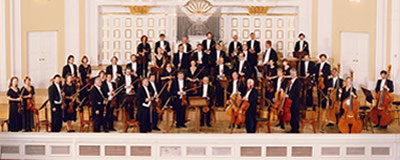
The
Mozarteum has established itself as the pre-eminent keeper of the flame of
Mozart’s legacy through its many recordings (including the complete Mozart
symhonies), busy international touring, and appearances at the Salzburg
Festival. Presented by Lincoln Center, the Wasington PAS – Kennedy
Center, Boston Celebrity Series at Symphony Hall, Chicago’s Orchestra Hall.
Tour repertoire includes Mozart, Beethoven, Schumann, Stravinsky and
Haydn.
CDs:
Cappriccio, Chesky, JVC, Erato, Sony
“plays
with the special authority of musicians swinging into down-home
styles…dazzling” The
Washington Post
Mozarteum
Orchestra of Salzburg
Ivor
Bolton, Chief Conductor
The
history of the Mozarteum Orchestra of Salzburg dates to the year 1841 when
citizens of Salzburg, together with Mozart’s widow Constanze, founded the
“Cathedral Music Association and Mozarteum,” which was devoted to the
“refinement of musical taste with regard to sacred music as well as
concerts.” Through the 19th
century the orchestra, not yet known as the Mozarteum Orchestra, played hundreds
of concerts and became the center of Salzburg’s musical life, performing
symphonic and operatic repertoire as well as accompanying burlesques and plays.
It was only in 1908 that the orchestra received its present name.
The
modern history of the Orchestra begins in 1920, with Bernhard Paumgartner’s
invitation to the Mozarteum Orchestra to participate in the inaugural Salzburg
Festival. Since then, the
orchestra worked with many famous guest conductors, including Karl Böhm, Hans
Knappertsbusch, Clemens Krauss, Josef Krips and Paul Hindemith, in later years
also with Riccardo Muti and Nikolaus Harnoncourt. Former principal conductors
include Leopold Hager and Hans Graf.
Today
the MOS is the symphony orchestra of the Province and City of Salzburg. With its 91 full-time musicians it contributes considerably
to musical life of the shores of the Salzach, giving on average 130 performances
annually. In the summer the MOS is
busy in the Salzburg Festival. From
September to June it divides its time between performances as the opera
orchestra of the Salzburg Theater, plays the large-scale symphonic repertoire in
the Great Festival Hall, and cultivates the Viennese classics in the
International Mozarteum Foundation.
International
tours are an important component in the MOS’s concert life.
The ensemble frequently performs in European music centers, and travels
regularly to North America and the Far East.
Their 2002 U.S. tour included the first visit in the orchestra’s
history to the Pacific Northwest, with concerts in Seattle and Vancouver.
Tours to Latin America, South Africa and Australia are scheduled for
years to come. On tour the
orchestra travels with approximately 50 musicians to perform the repertoire with
which the Mozarteum is most closely associated:
Mozart, Haydn, Beethoven and Schubert.
Over
the last 10 years the Mozarteum Orchestra has recorded over 25 CDs on a variety
of labels. Most notable among them
is a complete Mozart Symphony cycle, the most comprehensive recording based on
the New Mozart Edition, on the Capriccio label.
IVOR
BOLTON
Chief Conductor, Mozarteum Orchestra of Salzburg
Ivor
Bolton is established as one of Britain’s most internationally active and
versatile conductors, in repertoire ranging from baroque to contemporary. He was
educated at Cambridge University, the Royal College of Music, and the National
Opera Studio in London. He was Music Director of English Touring Opera in
1991/2, Music Director of Glyndebourne Touring Opera from 1992-1997, and Chief
Conductor of the Scottish Chamber Orchestra from 1994-1996. He is the founding
music director of the Lufthansa Festival of Baroque Music in London. In 2004 he
will become Chief Conductor of the Mozarteum Orchestra of Salzburg.
In
recent seasons Ivor Bolton has forged a close link with the Bavarian State Opera
in Munich where he has enjoyed huge public and critical acclaim in many new
productions, including a sequence of Monteverdi and Handel operas. He was
presented with the prestigious Bayerische Theaterpreis by the Prime Minister of
Bavaria in November 1998.
Ivor
Bolton made his Covent Garden debut in 1995, and has enjoyed a long association
with Glyndebourne, where his most recent project was a new production of
Gluck’s Iphigenie en Aulide in the
2002 Festival. Other UK operatic engagements have taken him to English National
Opera, Welsh National Opera, and Opera North.
He
made his Salzburg Festival debut in 2000 with Gluck’s Iphigenie
en Tauride and will return to Salzburg in 2003 for a new production of Die Entführung aus dem Serail. Elsewhere in Europe he appears
regularly at the Maggio Musicale in Florence and in other major houses including
Paris, Hamburg, Amsterdam, Brussels, Geneva, Berlin and Leipzig. Operatic
engagements outside Europe have included San Francisco, Sydney, and Buenos
Aires.
Ivor
Bolton has worked with many of the UK’s principal symphony orchestras, as well
as with leading orchestras throughout the world, where concert engagements in
recent seasons have included Vienna, Salzburg Festival, New York, Boston, the
Royal Concertgebouw Orchestra in Amsterdam, Paris, Florence, Rotterdam and the
Zurich Tonhalle Orchestra. He made
his debut at the Proms in 1993, and conducted Bach’s St
John Passion at the Proms in 2000. Future concert engagements include the
Orchestre National de Lyon, the Orchestra Sinfonica di Milano Giuseppe Verdi,
and the Freiburg Baroque Orchestra.
Future
operatic engagements include many new projects in Munich (including a new
production of Die Zauberflöte), Entführung
at the Salzburg Festival, Alceste and A
Midsummer Night’s Dream in Brussels, La
Clemenza di Tito and Idomeneo for
the Maggio in Florence, and Poppea in
Paris.
His
many recordings include Xerxes, Ariodante and Poppea
from Munich, Dido and Aeneas and
Charpentier’s Te Deum for Teldec,
and the complete Bach harpsichord concerti. Future recording projects include
Handel’s Rodelinda for Decca with
Renée Fleming.

Reviews
|
SEATTLE
POST-INTELLIGENCER
Fresh,
energetic Mozarteum Orchestra struts its stuff
Wednesday,
April 17, 2002
By
R.M. CAMPBELL
WHERE:
Benaroya Hall
If
an American orchestra were to tour with the program the Mozarteum Orchestra of
Salzburg played Monday night at Benaroya Hall, most likely it would be
criticized for lack of imagination.
But
the Mozarteum is not an American orchestra. Its long and distinguished history
speaks another story, dating to 1841, a half century after Mozart's death in
Vienna. One does not look to the Mozarteum for the newest trends in music
fashions, at least on tour, but for the Classical era on which its reptuation is
based.
Thus
the 45-member orchestra's choice of Mozart and Beethoven was welcome in its
Seattle debut, especially given its illuminating and riveting performance.
Led
by its chief conductor since 1995, Hubert Soudant, the orchestra sounded fresh
and energetic. Tempos were sprightly -- some thought too much so on occasion --
and ensemble cohesive. The Dutch conductor likes color and invested everything
he did with it: Whole swatches of it breathed life into very familiar music. He
likes transparent textures and knows how to achieve them. Inner voices were
never swallowed up as a sacrifice to the whole.
Mozart's
"Prague" Symphony (K. 504) opened the concert. It had all the drama of
an opera, rich in theater but never lacking in grace or elegance. The
introduction in the first movement had the right amount of somberness and
mystery before it leapt into the following Allegro. The slow movement was
handsomely molded, with hints of darkness here and there. The conclusion had
genuine power but it was never sound for sound's sake. Gravity and purpose were
coupled with bouyant speed.
The
Austrian pianist Ingrid Haebler was scheduled to tour with the orchestra, with
which she has long been associated. Because of ill health, she canceled and
Valery Afanassiev replaced her. Eccentric in manner, the Russian-born pianist,
who now lives in Versailles, did not get universal acclaim for his reading of
Mozart's E-flat Piano Concerto (K. 271): too slow, too unconnected.
But
that was not my view. He may be odd to look upon at the keyboard, but does that
really matter? His tempos were not as fast as others, or perhaps as bracing, but
to my ear, Afanassiev made sense every bar of the way. He brought purity of tone
to this great concerto and the kind of clarity one dreams about. There was a
seeming effortlessness and vividness not derived from speed or volume. His
musicianship may appear to be spontaneous but it was carefully considered. The
line was elastic but not loose.
Beethoven's
Fourth Symphony concluded the concert. I found little to dislike. It had
Soudant's typical variety of tone color, dynamics and tempos and the orchestra's
customary sense of precision. The conductor has thought a lot about this piece,
but his ideas never once gave the image of something stale. The Adagio was
spacious -- a little too quick? -- and heartfelt while the concluding Allegro
was relaxed, Rossini-like in its fleet-footedness. It just sped along with a
sense of joy and freedom.
The
standing ovation from the capacity house seemed inevitable.
|
|
Newsday,
Long Island
Mozart's Swan Songs, Elegance in Scores
By Daniel Schlosberg
April 8, 2002
MOZARTEUM ORCHESTRA OF SALZBURG.
Music by Mozart. Valery Afanassiev, pianist. Hubert Soudant, conductor. Tilles
Center.
WHY
IS IT that so many great composers' last works take on a distinctly religious
quality, as if foreshadowing their own fates? Mahler's Ninth Symphony and his
"Das Lied von der Erde," are devotional farewells in their way, and
Wagner's "Parsifal" strives for a candid spirituality previously
obscured from the aesthetic experience of his earlier operas.
So,
too, with Mozart. In 1791, his final year, he wrote in a reflective directness
that makes his expression seem clairvoyant. The deeply felt arias of the priest
Sarastro in "The Magic Flute," the ethereal subtlety of his Clarinet
Concerto, and the monumental Requiem all share a sense of finality that can only
be called religious.
Add
to this list of spiritual swan songs the last of his 27 piano concertos, in
B-flat Major, K. 595, an incomparable masterpiece that was given its full due
Saturday at the Tilles Center. It's
as if Mozart were saying, "No more drama." So uniformly delicate is
the sound world he creates that it defies the inherent theatricality of pitting
soloist with orchestra.
Pianist
Valery Afanassiev, a cult figure in Europe whose fey stage presence and bony
fingers create an entirely different kind of other-worldliness, played with an
immense restraint and an elegance that fully conveyed the subtle mood of the
score. His colorful bio in the program lists Hans Knappertsbusch and Otto
Klemperer among his favorite conductors, and the leisurely tempos he chose for
the concerto confirmed these allegiances. Most moving was his consistently
beautiful sound, which managed to be warm and rich but also refined.
Meeting
him every step of the way was the Mozarteum Orchestra of Salzburg, a well-known
chamber orchestra based in Mozart's birth city and currently in the midst of a
U.S. tour. This admirable, buoyant group is best known for its concerto
recordings with Andras Schiff, which teem with vibrancy; hearing the group live
confirmed this happy impression.
It's
hard to imagine a chamber orchestra with a more precise sense of balance or a
more singular sense of expression. While the players have probably performed the
Symphonies No. 38 (Prague) and 41 (Jupiter) hundreds of times, they approached
them on this outing with a child-like sense of discovery.
Credit
must also be given to conductor Hubert Soudant, who left no detail of the score
unattended. While you could conceivably complain about a lack of large design in
Soudant's over-lively gesturing and some entrance problems in the trumpets, you
also had to recognize that this was Mozart playing - and conducting - of the
highest level.
The
finale of the "Jupiter" Symphony, Mozart's last statement in the
genre, is always an uplifting experience if performed well, but on this occasion
it was transcendental.
|
“The
string playing was soft and round in attack, warm-toned, sweetly tuned, and
lithe. The orchestra makes a
beautiful, relaxed sound that never goes into overdrive and never descends into
sloppiness. It is a sound that
speaks of a time and place that is not our own but of emotions that are.”
The Boston Globe 4/19/99
“The
advantages of importing Mozart directly from the source were plain in the
all-Mozart program by the Mozarteum Orchestra of Salzburg on Wednesday at
Symphony Center.”
Chicago Tribune 4/16/99
“The
Mozarteum orchestra of Salzburg make a wonderful sound.
The strings are silvery and confident, the winds are full-throatedly
earthy and the horns proclaim their hunting lineage with every braying
fanfare.”
The Washington Post 4/15/99
“the
performances were superb”
Newsday
“Splendid
ensemble, virtuosic and polished instrumental skills, unforced balances and a
disarming and relaxed stylishness marked all the playing.”
Los Angeles Times
“plays
with the special authority of musicians swinging into down-home
styles…dazzling”
The
Washington Post
Programs
Subject
to Change
MOZART
Symphony No 34 in C K 338
MOZART
Piano Concerto No 20 in D minor K 466
++
BEETHOVEN
Overture Prometheus
SCHUMANN
Symphony No 2 in C Op 61
--------------
BEETHOVEN
Symphony No 2 in D Op 36
MOZART
Piano Concerto No 23 in A K 488
++
STRAVINSKY
Jeu de cartes
HAYDN
Symphony No 96 in D (The miracle)
------------------
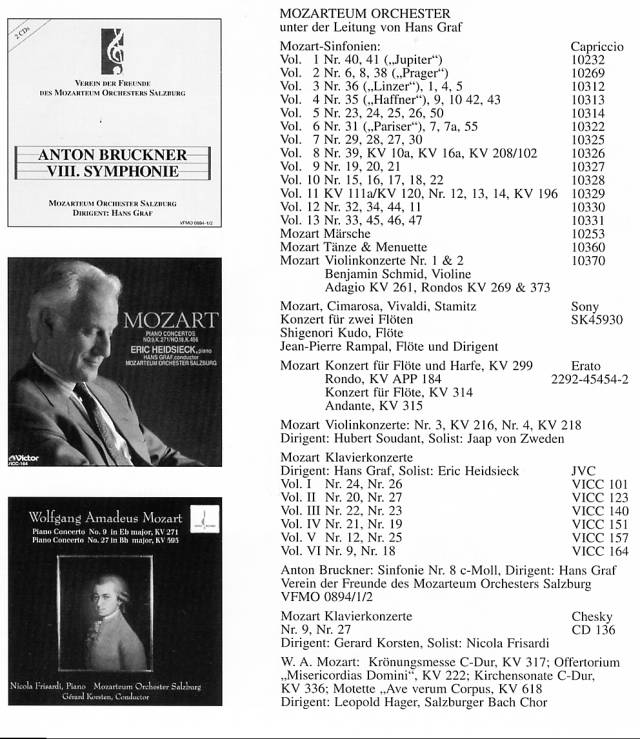
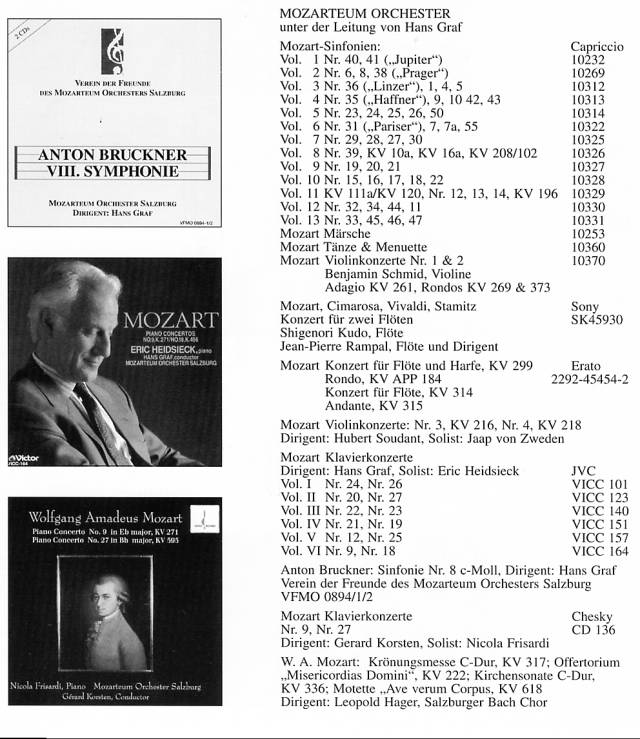
Discography
Click
to enlarge:
Personal
and Biased Comments About The Artist
To
work with an artist so directly connected to one of the greatest composers is a
real honor. North
American audiences, on hearing the orchestra for the first time, feel honored,
too. The
Mozarteum speaks Mozart fluently, as very few artists can.
Why? In
part it’s a broad cultural connection to Austrian and the region, but the
greater part, I think, is their immersion over the decades, in the performance
of Mozart. They
have worked intensively with many of the great Mozart interpreters, they have
heard the others, they make music of Mozart and his contemporaries on a regular
basis. They
are familiar with the various strains in contemporary Mozart interpretations,
have considered them, and have incorporated those which make sense within their
own tradition.
What they create is deep, natural and affecting.
Technical
Requirements
Concert
Presenter to provide the following:
45
chairs, 35 music stands, podium, for programs with piano there needs to be an
excellent quality grand piano tuned to A=442 on the day of the performance, 2
hours rehearsal time on the concert stage just prior to the doors opening to the
public, individual dressing rooms for the conductor and soloists, and separate
dressing areas for the men and women of the orchestra.
At least two loaders to unload the orchestra's equipment from the truck
before the concert, and back into the truck following the concert.
Light refreshments backstage such as juice and cookies are greatly
appreciated.