|
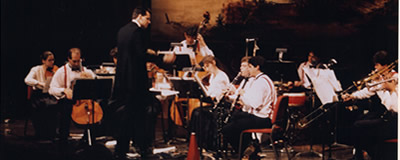
Classic rags, symphonic
parodies, novelty numbers, Tin Pan Alley tunes, Rick Benjamin’s historical &
witty introductions, and accompanied silent film make for a unique, varied
event! With hundreds of concerts at venues such as Lincoln Center and the
Ravinia Festival, and with a collection of thousands of 1900’s pieces in full
orchestrations of the era, the PRO is the acknowledged leader in its field.
Programs include "Scott Joplin and the Original Kings of Ragtime," and "’Round
the Christmas Tree" and programs with silent films.
"The music is incomparably sweet
and stirring. And Rick Benjamin, who founded and conducts the PRO, is a
musician of wit and sensibility."
Philadelphia
Inquirer

Biography
In the summer of 1985, Rick
Benjamin discovered in an abandoned warehouse the long lost collection of
orchestra scores of Victrola recording star Arthur Pryor, and with it the
inspiration for the Paragon Ragtime Orchestra. Mr. Benjamin gathered Juilliard
colleagues to perform his turn-of-the-century treasures, and the PRO was born.
Recordings soon followed, along with the orchestra's 1988 debut at Lincoln
Center's Alice Tully Hall, the first at Lincoln Center by a professional ragtime
ensemble.
Today, the PRO is regarded as
the leading exponent of vintage American popular music, and it remains the
world's most active ensemble of its kind. Notable engagements include concerts
for the inaugural season of the Kimmel Center in Philadelphia, the Ravinia
Festival, the Washington Performing Arts Society at Lisner Auditorium, the
Brucknerhaus in Linz, Austria, and around New York at the Tilles Center, Lincoln
Center, the South Street Seaport and the 92nd Street "Y." The PRO is frequently
heard in historic theater and movie palaces such as Cleveland's Ohio Theater,
Chattanooga's Tivoli and the Rialto in Joliet. The Orchestra was selected to be
America's "Ambassador of Goodwill" at the World's Fair in Seville, Spain. The
PRO has performed on National Public Radio for the BBC, as well.
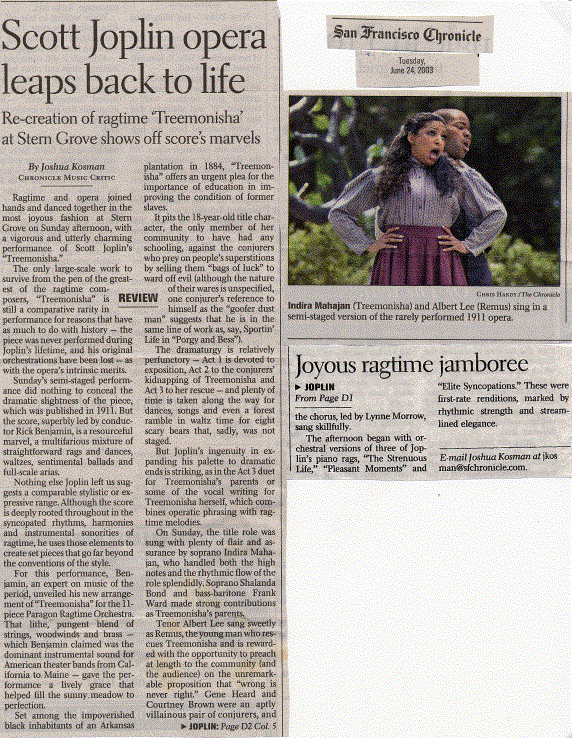
Using the orchestra’s
collection of 10,000 fully-orchestrated scores as a guide, Rick Benjamin worked
for four years to orchestrate Scott Joplin’s opera, “Treemonisha.” The first
performance of the new orchestration was given at San Francisco’s Stern Grove
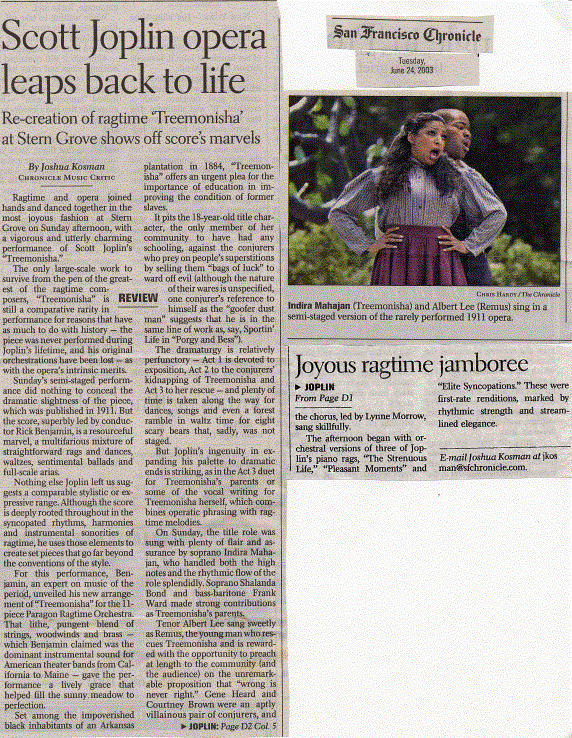
Festival in June 2003, to an audience of 3,500. The San Francisco’s Chronicle
headline read, “Scott Joplin opera leaps back to life - Re-creation of ragtime 'Treemonisha'
at Stern Grove shows off score's marvels.” This production has toured to Kansas
City, Winston-Salem, Lewisburg, Texarkana TX and Stillwater OK. The Capetown
(South Africa) Opera Company used Mr. Benjamin’s score as the basis for its
recent production.
The PRO was honored to serve
as the inspiration for a dance by the Paul Taylor Dance Company. Entitled “Oh,
You Kid!,” the dance was given its premiere with the PRO accompanying the Taylor
Company at the Kennedy Center Opera House for four performances followed by
performances at the American Dance Festival.
The PRO's repertoire is a
varied one, skipping from Blues to waltzes, from operatic parodies and novelty
numbers to marches and popular songs of the era. And of course there is the
syncopated centerpiece of the PRO's collection, the rag, in its magnificent
variety, from the symphonic to the slapstick. The orchestra accompanies silent
films of the era using the original scores to films by Charlie Chaplin, Buster
Keaton and Harold Lloyd. All are brought to life with chamber music polish in
authentic period orchestrations.
The orchestra’s discography
includes several discs on Rialto Records and New World Records. They have
recorded “George M. Cohan – You’re a Grand Old Rag” and “From the Barrelhouse to
Broadway” for New World Records this year featuring music of African-American
popular composer Joe Jordan. “The Paragon Ragtime Orchestra Finally Plays ‘The
Entertainer’” is the PRO’s latest recording on the Rialto label, featuring the
best-known rags of Scott Joplin and other classics ragtime composers.
RICK BENJAMIN
Founder and Director, the
Paragon Ragtime Orchestra
Rick Benjamin, founder and
director of the Paragon Ragtime Orchestra, leads a multifaceted career as a
performer and scholar. Mr. Benjamin is an authority on late 19th and early 20th
Century American music, and has been recognized as a leading force of the
Ragtime Revival. He is curator of the Arthur Prior, Simone Mantia, B.F. Alart,
and Frank H. Wells theatre orchestra collections, which total some 10,000
fully-orchestrated selections from the 1890s – 1920s..
In addition to his various
duties with the PRO, Mr. Benjamin a career and guest conductor, arranger, and
pianist; he has also served as a musical consultant and conductor for motion
pictures, radio and television. Mr. Benjamin’s conducting engagements include
the National Symphony Orchestra of Ireland, New Jersey Symphony, the Olympia
Symphony in Washington State, the Aalborg Symphony (Denmark) and the Iceland
Symphony Orchestra. His articles on popular music have appeared in several
periodicals, and his lecture tours take him to colleges and universities
throughout the United States. Mr. Benjamin recently led the Opera Memphis
production of Scott Joplin's opera "Treemonisha," using Mr. Benjamin’s own
reconstruction of Joplin’s lost orchestrations. Mr. Benjamin continues his work
on his book about the music of the Ragtime Era.
Rick Benjamin is a member of
the music faculty at Bucknell University in Lewisburg, Pennsylvania. Mr.
Benjamin attended the Juilliard School as a scholarship student.
Review
Quotes
“Scott Joplin opera leaps
back to life - Re-creation of ragtime 'Treemonisha' at Stern Grove shows off
score's marvels.” San Francisco Chronicle
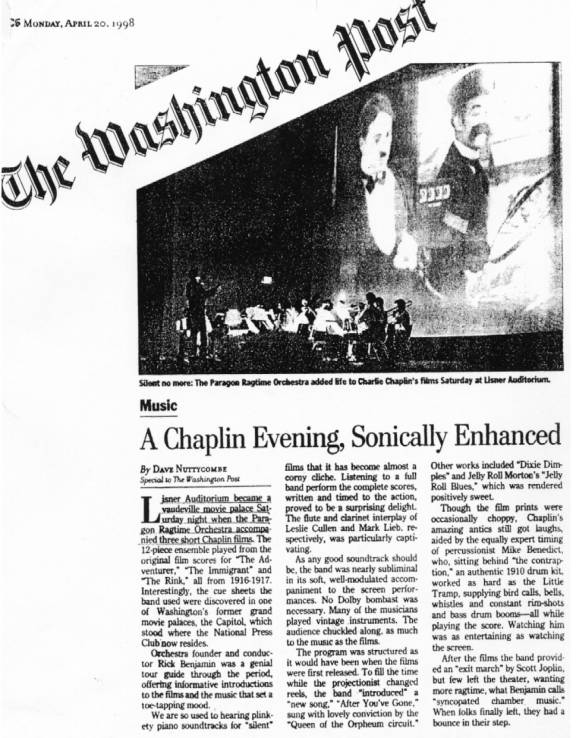
“Summoning both the subtle
interplay and brassy vitality these pieces demand, the PRO does itself proud.”
The Washington Post
“As you listen…you’ll begin
to understand why ragtime captured America for a whole generation.” CD
Review Magazine
“Four stars…The music is
incomparably sweet and stirring. And Rick Benjamin, who founded and conducts the
PRO, is a musician of wit and sensibility.” The Philadelphia Inquirer
“have such an infectious
beat that you’ll hardly be able to resist tapping you toes.” Classics Today
“all played with polish,
authenticity, and all-out enthusiasm…under Rick Benjamin’s inspired direction.”
Classics Today
Reviews
Cover Story in the May/June 2009 Fanfare Magazine!
(click on cover image for full text of the feature)

|

July 2, 2008
Benjamin's Ragtime Band Captures the Real Cohan
By BARRYMORE LAURENCE SCHERER
July 2, 2008; Page D7
New York
I am seated in the refurbished beaux-arts
auditorium of the American Academy of Arts on West 154th Street. Beneath the
elegant sculpted muses, time moves backward this warm spring day as the air
vibrates with the infectious music of George M. Cohan (1878-1942), the "Yankee
Doodle Dandy," as he himself put it, "born on the Fourth of July." In fact,
though the family rigorously defended that Independence Day claim, Cohan's birth
certificate was dated July 3.
|
New World Classics
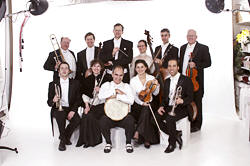
The Paragon Ragtime Orchestra with its director and conductor, Rick
Benjamin (top row, center).
|
The recording session isn't of Cohan chestnuts
filtered through James Cagney or Broadway's "George M!" This is authentic Cohan
played in the original ragtime-era arrangements. Included are familiar numbers
like "Give My Regards to Broadway" and "Yankee Doodle Dandy" from the 1904 show
"Little Johnny Jones"; the rousing World War I song, "Over There"; and medleys
from such hit shows as "George Washington, Jr." (1906), "Forty-Five Minutes From
Broadway" (1906), "The Honeymooners" (1907) and "Little Nellie Kelly (1922),
performed with conspicuous élan and attention to historic performance practice
ordinarily lavished on Bach, Handel and Rossini. On stage is the Paragon Ragtime
Orchestra; on the podium is its founder and conductor, Rick Benjamin.
The first things you notice are the numbers'
exceptional tunefulness and syncopated rhythmic infectiousness. Apart from
marches and waltzes, Cohan's music often reflected the popular dances of his
day: the one-step, the two-step, the high-stepping cakewalk, the sultry tango,
and such anthropomorphic variations as the bunny hug, grizzly bear, turkey trot
and -- longest surviving -- the fox trot. Ragtime is some of the happiest music
on Earth, and listening to Mr. Benjamin's performances it is easy to understand
why he has devoted his life to it.
A pianist and tubist by training, Mr. Benjamin
discovered his calling as an 8-year-old in the 1970s: Seeking amusement while
visiting his grandparents' New Jersey home, he wandered out to the garage, where
he discovered their 1917 Victrola. He wound it up, put one of their records on
the turntable, lowered the steel needle to the shellac, and "as music poured out
of the dusty ancient machine," he recalls, "I was overwhelmed by a feeling of
complete wonder: A new world, glowing with life, was calling out to me from
another time." He was hooked.
"The sounds were somehow much more meaningful to
me than the current pop music of the Gerald Ford era," he says. "The old time
vocalists on these records -- people like Billy Murray and Nora Bayes -- sang
with such gusto, and bands played their marches and rags with such warmth and
obvious delight, that I knew in my bones that these performers and their
composers were expressing their sheer joy in life through their music."
In 1985, while studying at the Juilliard School,
Mr. Benjamin made his second life-changing discovery: Through a convoluted
series of personal connections beginning with his ex-bandsman grandfather, he
was directed to a derelict warehouse in Asbury Park, N.J. Inside was the vast
music collection of Arthur Pryor (1870-1942), one of the star band conductors of
the Victor Talking Machine Co. (predecessor of RCA-Victor and BMG).
Pryor, a trombone virtuoso and concertmaster of
John Philip Sousa's band, had proved so adept at conducting and supervising that
ensemble's recordings that Victor invited Pryor to form his own band, which
quickly rivaled in popularity that of his former chief. Pryor's collection
comprised scores and parts of over 3,600 pieces, a veritable time capsule of
popular and concert music of the era. Equally important, the arrangements
reflected the makeup of theater, moviehouse and recording orchestras before the
rise of Dixieland and swing -- and thus preserved the sound of the era of Sousa,
Victor Herbert, Cohan and their colleagues.
Mr. Benjamin's acquisition of the Pryor archive
inspired him to establish an ensemble to play this repertoire. The ragtime
revival had already gotten under way after several Scott Joplin rags were used
in the score of the 1973 film "The Sting." In April 1986, the Paragon Ragtime
Orchestra presented its inaugural performance to a packed house at Juilliard's
Recital Hall. The program included the original 1912 score of W.C. Handy's
"Memphis Blues," selections by Irving Berlin and Victor Herbert, and a
manuscript orchestration of Joplin's "Peacherine Two-Step."
Afterward, Vincent Persichetti, a distinguished
composer and Juilliard professor, approached Mr. Benjamin backstage, calling the
repertoire "'America's Original Music, simple and utterly profound, all at
once,'" recalls Mr. Benjamin. "He advised me to make its preservation my life's
work." A few weeks later, the record producer Thomas Frost, a Juilliard guest
lecturer that semester, signed the Paragon Ragtime orchestra to a recording
contract. "I became so engrossed developing my orchestra full time and curating
the thousands of historic orchestrations I had found that one day I cleaned out
my locker and left [Juilliard] without a word."
Today, Mr. Benjamin and the Paragon have a string
of CDs to their credit, many available for sale at their Web site (www.paragonragtime.com).
One of these, "The Whistler and His Dog," is the recording heard along Main
Street, USA at Disneyland, Disney World and Euro Disney. Paragon also tours the
performing-arts-center and university circuits, playing ragtime concerts and
accompanying silent films with authentic period scores.
Central to re-creating the authentic sound of the
period is the instrumentation of these scores, known as "11 and piano." The
basic Broadway pit orchestra of the time consisted of two violins (for the
melody), viola, cello (for tender countermelodies), bass, flute (skipping
decoratively around the fiddles), clarinet, two cornets (brightly underlining
repeats of the violin melody), trombone (swooping up and down), percussion and
piano. But much of the performance style also depends on a characteristic
articulation of notes and phrases. Ragtime and other pre-swing music is
remarkably crisp in sound, with important notes and groups of notes accentuated
separately. This is quite different from the smooth, crooning, alto-sax manner
of the big-band era.
Adhering to this pre-swing style lends an
exceptional vitality and punch to Paragon's accounts of everything from Joplin,
Eubie Blake and Joe Jordan to Herbert, Pryor and a host of composers whose names
would be forgotten today were it not for Mr. Benjamin's joyous efforts.
Discussing the Cohan disc, slated for release in
November, Mr. Benjamin observes that "Cohan's status as a show-biz legend,
fostered by the 1942 Cagney biopic 'Yankee Doodle Dandy' and the 1968 Broadway
show 'George M,' led to constant updating of his music to make it commercially
salable to each new generation." With this new recording, Mr. Benjamin says he
aims "simply to make available on record -- for the first time ever -- Cohan's
music as he heard it himself, in authentic period orchestrations by the
arrangers who worked with him."
And as I listen, buoyed to the rafters of the
American Academy of Arts by the delectable cheer of Cohan's works, I realize the
significance of Mr. Benjamin's role in protecting an important American
treasure. The result will not just be a pleasure to hear but for many a true
revelation.
Mr. Scherer writes about music and the arts for
the Journal. He is a contributor to the new book "Giacomo Meyerbeer: A Reader"
(Cambridge Scholars Publishing).
|
|

George M. Cohan: You're a
Grand Old Flag
Review by
Uncle Dave Lewis
George M. Cohan is
an American institution that most Americans don't know anything about; the
closest anyone usually comes to Cohan is through his representation as a
fictionalized character in the classic Hollywood film Yankee Doodle Dandy
(1942), where he was portrayed by James Cagney. Aficionados of the Broadway
stage might remember Joel Grey's similarly fine turn in George M! (1968),
but both of these ambitious and highly entertaining productions don't do much to
convey a sense of Cohan's actual achievements; he may have been the proverbial
straw that broke the camel's back in terms of liberating American entertainment,
once and for all, from European domination. In a way, Cohan himself was
complicit with such re-invention of his legacy; he was happy to approve James
Cagney's comment in Yankee Doodle Dandy that he'd never appeared in a
film, though Cohan had, in fact, made a few, most of which no longer exist.
Cohan spent one day from among his 50 years in entertainment in the recording
studio in 1911, making eight records that he felt poor and unrepresentative;
Cohan never recorded again. That begs the question -- how does one, a century
after Cohan's prime, cut through the hype and make contact with the real George
M. Cohan?
It appears that
Rick Benjamin and the Paragon Ragtime Orchestra have found the answer in New
World's George M. Cohan: You're a Grand Old Rag. Employing expert Cohan
interpreter Colin Pritchard, period-conscious comedienne Bernadette Boerckel --
who indeed sings with the clear enunciation and light vibrato favored by
historical singers like Ada Jones -- and, for the most part, the original
orchestrations created by Cohan's staff arrangers for his productions, Benjamin
and the Paragon hit the vein of this distant era and make Cohan's simple
creations jump and sparkle. Cohan's work is ruthlessly popular, jingoistic, and
straightforward, and it does not well survive modernization, though that has not
deterred a cottage industry of sorts to spring up around his work in terms of
tributes. New World's George M. Cohan: You're a Grand Old Rag is not a
"tribute," but the real thing, and it comes with an excellent essay by Benjamin
that strips away the varnish on Cohan's façade and places him in the proper
context; a dominant figure in show business whose work was idolized by younger
peers like Irving Berlin, setting standards that led to American entertainment
as we know it. This is a superb effort and sheds considerable light on a murky,
yet highly significant, topic in regard to Americana.
|
|
A 1920s Buster Keaton film still
delights
"The General" is shown at the Lucas as an orchestra
performs the score.
Bill Dawers
SPECIAL TO THE MORNING NEWS
The Savannah Music Festival pulled off something
extra special on Sunday afternoon at the Lucas Theatre. Built in 1921, the
Lucas was originally a movie palace, a place to relax and enjoy the escape
offered by a Hollywood film accompanied by live musicians.
And that's exactly what the audience got at a
matinee showing of Buster Keaton's "The General" with the 12-piece Paragon
Ragtime Orchestra performing the film's light, uplifting, comical score.
The 1927 slapstick comedy stars Keaton as Johnny
Gray, a hapless railroad engineer who does everything wrong - and in the process
gets everything right.
At first rejected by the Confederate Army, he
manages to rescue The General, the stolen locomotive he's the engineer for, then
defeats the Union Army in battle, earns his officer's stripes, and gets the
girl.
Keaton was at the height of his fame when he made
the movie, which is brimming with examples of his comic timing, physical daring,
and frantic energy.
Keaton manages to express as much feeling with his
face as his body. With his long nose, high cheekbones and big eyes, he conveys
joy, surprise, fear, irritation, whatever emotion a scene demands.
Dressed in vintage garb like the rest of his
musicians, conductor and pianist Rick Benjamin led the Paragon in a spirited
performance. There were a few easily recognizable songs, like "Dixie" and
"I've Been Working on the Railroad." But much of the music was simply a direct
expression of the action on the screen.
In addition to an extended chase scene with one
slow-moving locomotive trying to catch up with another, Keaton is faced with a
variety of obstacles - lightning, a bear, a rainstorm and a broken sword. And
the Paragon was right there, setting the mood. Sometimes the vintage drum set
stood out, sometimes the beat was set by the violins, while at other times, the
cornet seemed to mock Johnny Gray's earnestness.
The combination of film and music elicited
a lot of laughter from the audience, even when a train
fell into a river as it traversed a burning bridge, even as Keaton unwittingly
killed a Union sniper with his broken sword.
Here's hoping the Savannah Music Festival
will treat the city to a similar show next year.
|
|
Knoxville News
Sentinel
Music, silent movies
mix well for entertaining night
By HAROLD DUCKETT
February 11, 2005
Tennessee Theatre buffs
nostalgic for the historic movie palace's golden era would have enjoyed the
concert by the Paragon Ragtime Orchestra, which brought the silent movie period
to life Tuesday night at Carson-Newman College.
The 12-player, New York-based orchestra brought along its own early 1900s
projector for showing short, silent-era movies, for which the group performed
the music that originally accompanied the films.
The program featured the 1922 "Cops," staring Buster Keaton; "Never
Weaken," made in 1921 and starring the silent movie superstar, Harold Lloyd; and
Charles Chaplin's 1917 "The Adventurer."
According to the ensemble's conductor, Rick Benjamin, who has built a career out
of accompanying silent movies, by 1916 there were 21,000 movie theaters in
America, about half of which had orchestras that accompanied the silent films.
Much of the music for these early films were not original scores at all but
compilations of fragments of the popular music of the day. Sent out, along with
the movie reels, was a list of pieces, which the local conductor would put
together for the performance. The accompanying instructions indicated exactly
where in the movie each section of music was to be played.
Of
course, aside from the conductor, the most important musician in the band was
the percussionist, whose responsibility included providing all the bangs and
crashes for what was happening on the screen, no matter what music was being
played. The Paragon's percussionist, Kerry Meads, was an expert at getting just
the right sound when Keaton, Lloyd or Chaplin slipped and landed on their
behinds, kicked someone else in the rear or crashed through something. Such
moments were funny especially because of Meads' efforts.
Along with the Paragon's playing of Scott Joplin's 1907 "The
Gladiolus Rag," and W. C. Handy's 1913 "Jogo Blues," performed as musical
interludes as the projectionist got ready for another movie,
the whole show was terrific.
It
was a great window into the past.
|
(click to enlarge)
|
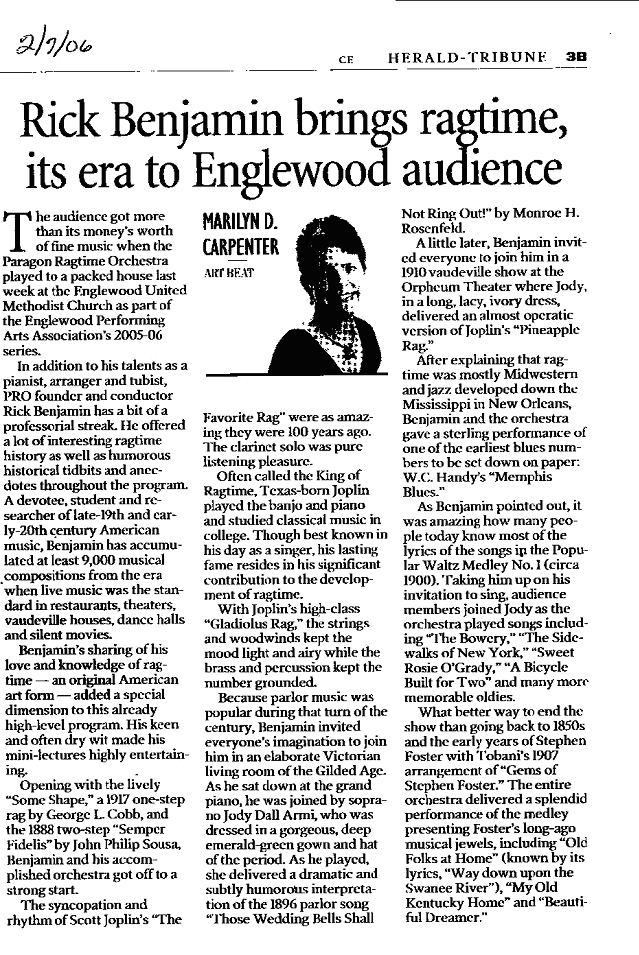
Sarasota Herald
Tribune
 |
San Francisco
Chronicle
 |
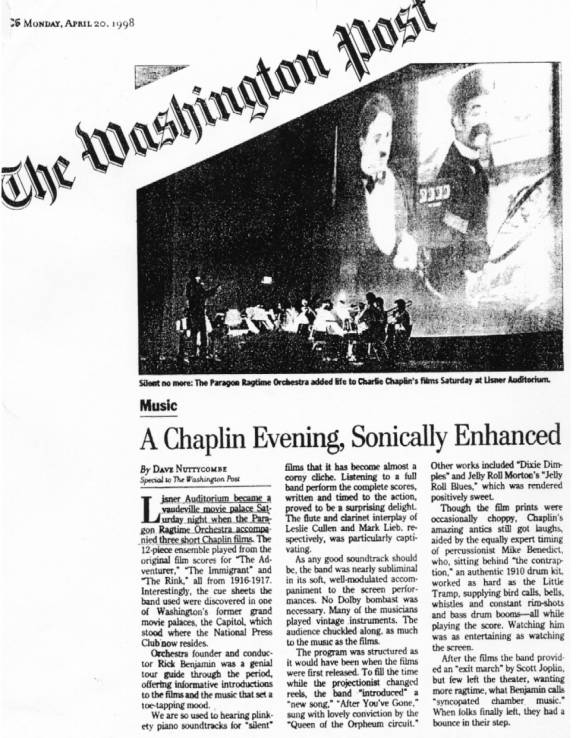
Washington Post
 |
|
Green Bay
Press-Gazette
 |
The Sarasota
Herald-Tribune
 |
|
CLASSICS
TODAY
January 7, 2004
Artistic Quality 10 / Sound Quality
10
BLACK
MANHATTAN
Theater and Dance Music by Members of the Legendary Clef Club
Paragon
Ragtime Orchestra
Rick Benjamin
Awet Andemicael (soprano); Edward Pleasant (baritone)
New
World Records- 80611-2(CD)
This
album collects ragtime and jazz classics of composer/ conductor James Reese
Europe and his contemporaries. The performances recreate the style of the
legendary Clef Club, a ragtime orchestra composed of African American musicians
that operated from 1910 to 1930. Europe was a prominent figure on the black
music scene during this time, as was Will Marion Cook, whose In Dahomey was the
first all-black musical, and its full-scale overture is this collection's most
substantial offering.
The
disc begins with Europe's exuberant "Castle Perfect Trot", a light,
bright, dancing romp that sets the high-spirited tone for the majority of the
disc. This, and numbers such as J. Turner Layton's "Strut Miss Lizze"
and Cook's "Swing Along!" have such an infectious beat that you'll
hardly be able to resist tapping your toes. This is as much true today as in
1902 when Bob Cole and the Johnson Brothers penned the song "When the Band
Plays Ragtime", which (as sung beautifully here by baritone Edward
Pleasant) offers a wry commentary on the social friction engendered by
"jazz" music. Cole and Johnson provide the disc's other vocal
offering, the exotic "Under the Bamboo Tree", in a stylized period
performance by soprano Awet Andemicael.
There's
plenty of variety here to give a representative sampling of some of the era's
finest pop music, and it's all played with polish, authenticity, and all-out
enthusiasm by the Paragon Ragtime Orchestra under Rick Benjamin's inspired
direction. The recording provides natural perspectives, warm presence, and
dynamic punch. Those who think ragtime begins and ends with Scott Joplin are in
for a pleasant surprise, while aficionados no doubt will treasure this uniquely
enjoyable disc.
--Victor
Carr Jr
|
Programs
The
programs described below give an excellent idea of typical PRO programs. The PRO tailors their programs to fit the venue and locale,
and so you will hear a different program on almost any given night.
These are not for publication.
SCOTT
JOPLIN & THE ORIGINAL KINGS OF RAGTIME
HI
THERE! (one step,
1915).............……………… James Reese Europe
WASHINGTON
POST TWO STEP (1889)… ……..John Philip Sousa
WHISTLING
RUFUS (cakewalk, 1899) …..………
Kerry Mills
ELITE
SYNCOPATIONS (two step, 1902)……..... Scott Joplin
Victorian
Parlor Song
IN
THE BAGGAGE COACH AHEAD (1896) ….. .Gussie L. Davis
Jody Dall' Armi, soprano
BALLIN’
THE JACK (medley fox-trot, 1913)……...
Chris Smith
HILARITY
RAG (1907)…….................................
James Scott
THE
GLADIOLUS RAG (1907)……..................……
Scott Joplin
Rick Benjamin, piano
THE
TOREADOR HUMORESQUE:
A
RAGTIME TRAVESTY ON ‘CARMEN’ (1918)......M.L.
Lake
*****
Iintermission *****
SCOTT
JOPLIN’S NEW RAG (1912)……….....……
Scott Joplin
Vaudeville
Speciality:
ROCKAWAY
(1917) .....................................”Luckey”
Roberts
Jody
Dall'Armi, comedienne
POPULARITY
RAG
(from
the Broadway show popularity , 1906)………
George M. Cohan
THE
MEMPHIS BLUES (1912)……...…………………
W.C. Handy
POPULAR
WALTZ MEDLEY No.2 (c.1900)……………arr.
Lake
The
Audience is Invited and Encouraged to Sing Along
Orchestral
Highlights from
“TREEMONISHA”
(1911)………………………………Scott
Joplin
You’re a Grand Old Rag: George
M. Cohan - a fresh and
compelling look at Cohan's music using original period orchestrations
(not available elsewhere), played on antique instruments Selections include
"The Yankee Doodle Boy," "Harrigan,"
“You’re a Grand Old Rag,” and “Over There!” This program features a
song & dance duo performing in Cohan’s style!
’Round
the Christmas Tree
Vintage
Yuletide Favorites
A
syncopated romp around the tree, which goes from Rick Benjamin’s own
"Nutcracker Rag: A Sweet
Travesty on Tchaikovsky" to a straight-forward suite from "Babes in
Toyland" to ragtime great Joseph Lamb’s “Reindeer Rag” to
Fillmore’s “Hallelujah (Chorus) Trombone.”
A nice mix of the sweet and the comical.
The program can be easily adapted to a more general holiday season
program, which you might call “’Round the Holidays.”
Black Manhattan
Theater
and Dance Music of James Reese Europe, Will Marion Cook, and Member of the
Legendary Clef Club
The Clef Club of New York City, Inc. was a fraternal and professional
organization for the advancement of African-American musicians and entertainers
in the 1900s. Rick Benjamin has
selected some of the finest of the work written for the Broadway stage and
brings it life with two vocal soloists.
Programs with Silent Films
All
of the following programs use the
original scores to the films
which were issued by the studios along with the prints of the films.
The PRO is the only orchestra touring with the original scores.
!NEW
PROGRAM!
Buster Keaton’s classic
feature,
STEAMBOAT BILL, JR. – with its original, studio-issued score played by Rick
Benjamin’s PARAGON RAGTIME ORCHESTRA
Mississippi riverboat thrills and intrigue abound
in one of Keaton’s most celebrated features. See some of the wildest stunts ever
filmed, including a real house that falls all around the star and a cyclone
scene that literally swept Keaton off his feet. Add to this the original score
in its first performances since the film premiered and you have a knock-out of a
theatrical event. Just add popcorn for a taste of multi-media perfection, the
old-fashioned way!
THE
CLOWN PRINCES - films of Chaplin, Keaton & Lloyd with the original scores performed by Rick Benjamin’s PARAGON RAGTIME
ORCHESTRA
Rick
Benjamin’s spoken introductions set the tone for Keaton’s Cops,
Lloyd’s Never Weaken, and
Chaplin’s The Pawn Shop (films
subject to change). Add period
theater orchestra selections and you have a night of multi-media perfection, the
old-fashioned way!
Buster
Keaton’s masterpiece THE GENERAL (1926) with the original score performed by Rick Benjamin’s PARAGON RAGTIME
ORCHESTRA
An
epic Civil War tale of love, locomotives & laughs - just add popcorn for a
night of multi-media perfection, the old-fashioned way!
Keaton’s 75-minute feature is bookended by period theater orchestra
selections. Rick Benjamin’s
spoken introductions provide historical perspective and a little more humor.
CHARLIE
CHAPLIN FILM FESTIVAL with the original
scores performed by Rick Benjamin’s PARAGON RAGTIME ORCHESTRA
Rick
Benjamin’s spoken introductions set the tone & the time for 3 Chaplin
shorts. Add period theater
orchestra selections and you have, once again, a night of multi-media
perfection, the old-fashioned way! Some
Chaplin films which may be a part of the program:
The
Adventurer (1917).
The Immigrant (1917).
The Pawnshop (1916).
The Rink (1916).
One A.M. (1916).
THE
GREAT STONE FACE: BUSTER KEATON CLASSICS with the
original scores performed by Rick Benjamin’s PARAGON RAGTIME ORCHESTRA
Rick
Benjamin’s spoken introductions set the tone & the time for 3 Keaton
shorts. Add period theater
orchestra selections and you have, once again, a night of multi-media
perfection, the old-fashioned way! Some
Keaton films which may be a part of the program:
The
Blacksmith (1922).
Cops (1922).
The High Sign (1921).
The Playhouse (1921).
Discography
click here
Personal
& Biased Comments about the Artist
“Paragon”
means “model,” “ideal,” “shining example,” “quintessence,” and
the PRO lives up to the name. Rick
Benjamin and his colleagues have very substantially raised the bar of excellence
for performance in the field. The
scholarship is broad and deep; the musicality is bold, subtle and is alive to
the humor in the scores. To
top it all off, Rick Benjamin and his partner, Leslie Cullen, bring an
entrepreneurial flair to the enterprise.
The
PRO is unique – most of the scores which they perform do not exist in any
other collection, and the orchestrations are all of the period (with a few very
notable exceptions). Their silent-
movie-with-original-score programs are only available through the PRO.
Rick
Benjamin lives the ragtime life – he drives a Model “T” (rarely to
concerts), lives in a stately Victorian home, collects guns (don’t ask) and
everything else of the era. He has
yet to be caught in a speakeasy.
Technical
Requirements
PARAGON
RAGTIME ORCHESTRA
Technical Requirements
Click Here for PDF of
Technical Requirements
CONTACTS
For programs & tech contact Rick Benjamin: Tel (570) 524-9511, Cell (570)
809-0551, and e-mail
[email protected]
For hotel/hospitality/travel arrangements contact Ms. Leslie Cullen: Tel
(570) 524-9511 and e-mail
[email protected]
The Presenter will provide the following:
PRODUCTION SCHEDULE – for a typical 8PM showtime, the orchestra uses
the following schedule. Adapt this according to your starting time. Please
have the appropriate crew available.
2:00 – 4:30PM – Load-in and Setup
4:30 – 6:30PM – Rehearsal
6:30 – 8:00PM – Break
8:00 – 10:15PM – Show
10:15 – 11:30PM – Breakdown
DVD PROJECTOR & SCREEN - if a film is to be included in program
• One high quality DVD projector suitable for your venue & screen
• One large, high-quality, properly coated, DVD screen placed or hung behind
orchestra. House tech crew should experiment in advance to get image focused
and fully on screen.
PROPS & FURNITURE
• One rug, approximately 4’ x 6’ to place under drum set.
• Eleven straight back chairs. Wood preferred.
• One stool approximately 3’ high (for string bass player).
• Sixteen music stands with stand lights. Old style stands preferred if
available.
• Two or more large potted palms or greenery. (optional)
• One table in lobby for sale of recordings.
SOUND SYSTEM
• Two microphones to be used through house system for conductor (wireless
system with lavaliere mic preferred if available).
• CD player to be used through house system during audience seating /
intermission (optional).
LIGHTING SYSTEM
• Best general stage wash available.
• Two electrical extension chords (25’) for orchestra stand light hook up to
house power.
• One follow spot (optional).
TECH CREW
• Projectionist (experience preferred) if a film is included in program
(unless Artist provides projectionist).
• One person familiar with sound system.
• One person familiar with lighting system and able to run follow spot
during performance.
• One or more persons to assist with orchestra load-in and stage set up,
break down, etc.
OTHER
• A hot meal (menu to be determined through discussion with orchestra
production associate) and soft drinks/water/coffee backstage for company of
14 during rehearsal and concert.
|