|
Joplin’s
masterpiece is an optimistic snapshot of an African-·American community’s
emergence from slavery. Led by the young woman Treemonisha, the townspeople
reject the local conjurers’ superstitions, in favor of hard work and learning.
The musical style speaks directly to modern audiences - from heartfelt arias to
rousing ragtime choruses, and Joplin’s score snaps to rhythmic life in
Rick Benjamin’s new,
historically-informed orchestration.
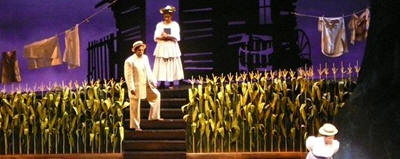
The production, originally from Opera Memphis, is a brightly-colored feast for
the eyes. It has mostly traditional feel with some modern touches, with the
emphasis on the characters’ human qualities.
“Scott Joplin opera
leaps back to life – Re-creation of ragtime ‘Treemonisha’ at Stern Grove shows
off score’s marvels”
San Francisco Chronicle

History
WHY A NEW VERSION OF
TREEMONISHA?
By Rick Benjamin
The main
difference between my reconstruction of Scott Joplin's Treemonisha, and
the earlier efforts by others is in the orchestration. The pioneering
productions of the 1970s and 80s conceived of this work in a very European way,
as heavy "grand opera" using a very large orchestra. In contrast, I see
Treemonisha as "opera" in name only. It is much more an amalgamation of the
well-established American traditions of vaudeville, tab-show, melodrama, and
minstrelsy, all held together by Joplin's marvelous music. For this, the ideal
accompaniment should be provided by the regulation twelve-piece theatre
orchestra of that era.
As you may
know, Treemonisha was never performed during Joplin's lifetime, and his
manuscript orchestrations for it were discarded in 1962. I began my
orchestration of the work after an extensive analysis of the seven thousand
period (1880-1920) theatre orchestra arrangements in my personal collection
(which includes a handful of surviving orchestrations by Joplin himself). During
that time I also collected and studied the considerable number of manuals on
arranging and orchestrating that appeared during that era. After five years of
careful study and work, my resulting score is, I think, faithful to Joplin's
intentions, as well as to the realities and conventions of theatrical production
of that period. Best of all, it actually suits the music.
As you
peruse my score of No. 4 - "We're Goin' Around," you'll notice a few things.
First, you'll see that the chords have been voiced in a very open manner, as was
the custom, to provide great fullness of sound using a very small number of
players. The strings are written for one-on-a part performance, with the 1st
violin covering the melody and with the 2nd violin and viola playing
rhythmic chordal accompaniment. The 'cello provides flowing counter-melodies in
support of the 1st violin. This was the unvarying string arranging technique for
vaudeville/operetta/musical comedy/silent picture pit orchestras of Joplin's
time. The woodwinds double the melody and principle harmonies and frequently
embellish them.
The cornets
provide sustained background harmony and at "big" moments reinforce the lead
vocal lines; the trombone doubles the bass line and occasionally plays
counter-melodies and short connective phrases. The drum set (then known as the
"contraption") provides unobtrusive rhythm and some atmospheric effects. As you
listen to our recordings, you'll notice that this authentic style of
orchestration makes for a full, clear sound. Yet the orchestra remains
transparent enough to make it ideal for accompanying singers - probably why
this combination of instruments and style of writing remained the theatre's
standard for so many decades.
As
mentioned above, the previous modern-day orchestrations of Treemonisha
were of much more grandiose dimensions; they depended on large choirs of strings
in a contrapuntal style, along with a great deal of "padding" by the French
horns and low brass. Yet there is no evidence that Scott Joplin had this is
mind; indeed all that survives of Treemonisha - the 1911 piano/vocal score -
mentions only the instruments of the small theatre orchestra (there then, go the
horns, oboes, bassoons, and tuba). All references to stringed instruments are in
the singular: "violin," "cello," etc. Finally, recent research shows that Joplin
wanted this work to tour (like his earlier A Guest of Honor) on the
regular theatrical circuits. To do so, it had to be playable by the standard
pit-orchestras of the era.
The idea
that Scott Joplin intended Treemonisha to be presented in a massive
"Metropolitan Opera" style is historically unfounded; it is pure romantic
daydream. Yet this notion was the basis of the initial productions of the 1970s
and 80s. But this is clearly at odds with the basic unpretentious nature of the
work itself - much like putting an exquisite Impressionist water color into a
giant, heavy, Baroque frame. In both cases the artwork itself is compromised.
This, so far, has been the lot of Treemonisha. As experienced via the
well-meaning, yet uniformed previous versions, Joplin's masterwork is regarded
merely as a curiosity. But with the historically correct, in-scale staging and
orchestra, it would be a charming, guileless, yet deeply moving part of the
repertoire.
RICK
BENJAMIN
Founder and Director, the Paragon Ragtime Orchestra
Rick Benjamin, founder and
director of the Paragon Ragtime Orchestra, leads a multifaceted career as a
performer and scholar. Mr. Benjamin is an authority on late 19th and early 20th
Century American music, and has been recognized as a leading force of the
Ragtime Revival. He is curator of the Arthur Prior, Simone Mantia, B.F. Alart,
and Frank H. Wells theatre orchestra collections, which total some 10,000
fully-orchestrated selections from the 1890s – 1920s.
In addition to his various
duties with the PRO, Mr. Benjamin a career and guest conductor, arranger, and
pianist; he has also served as a musical consultant and conductor for motion
pictures, radio and television. Mr. Benjamin’s conducting engagements include
the National Symphony Orchestra of Ireland, New Jersey Symphony, the Olympia
Symphony in Washington State, the Aalborg Symphony (Denmark) and the Iceland
Symphony Orchestra. His articles on popular music have appeared in several
periodicals, and his lecture tours take him to colleges and universities
throughout the United States. Mr. Benjamin has completed the reconstruction of
the lost orchestrations for Scott Joplin's opera "Treemonisha," and is
continuing work on his book about the music of the Ragtime Era.
Rick Benjamin is a member of the
music faculty at Bucknell University in Lewisburg, Pennsylvania. Mr. Benjamin
attended the Juilliard School as a scholarship student.
Reviews
|

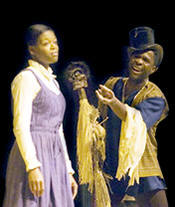 Rarely
performed folk opera, Treemonisha, played Rarely
performed folk opera, Treemonisha, played
By Kristen
Guth
Old Gold & Black Reviewer
November 3, 2005
The Secrest Series
performance of Scott Joplin’s opera Treemonisha on Oct. 27 in Wait Chapel
was well attended by students, faculty and other Winston-Salem residents.
The three-act opera was
presented with energetic stage presence from The Paragon Ragtime Orchestra &
Singers and created a beautiful balance between Joplin’s story, words and music,
which are all his original work. As the second Secrest Artists Series event
of the year, the ragtime opera centered on the way in which formal education
enables individuals to promote goodness in society. As an auto-biographical
reflection of Joplin’s childhood, this theme has equivalent poignancy for the
academic setting of the university community.
Joplin published
Treemonisha in 1911, consciously constructing the story to parallel his own
adolescent education. As a young boy, Joplin had access to a piano owned by a
white household for which his mother worked. Gradually, he taught himself the
musical basics on the piano, leading to his musical career. The protagonist of
Treemonisha likewise acquires an education through her parents’ labors in
a white-owned home.
The Paragon Ragtime
Orchestra, an 11-member group, began the program by playing a well-mastered
rendition of Joplin’s overture. The music flowed skillfully from the staff
lines on the sheet music down through the performers’ fingers and over the
chapel’s balcony, delightfully entrancing the audience with exuberant jazz
orchestration.
Although the group was small
in number, the accuracy with which each member executed their individual
parts contributed to the gorgeous melodic overlays that Joplin initially penned
almost a century ago.
The cast and Treemonisha
Octette successfully brought together the plot line through powerful voice
projection and dance, conveying excellent dramatic emotion overall. The
title role of Treemonisha was sung by Rita Addico-Cohen, whose high voice and
impressive command of the stage propelled the opera forward.
|
|
click to enlarge...
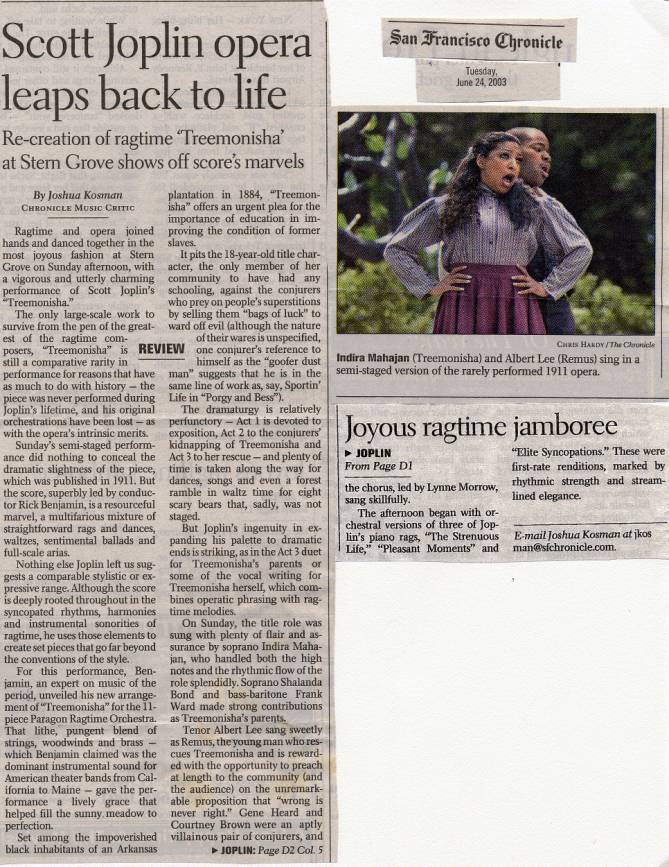
(as
above, but easier to read with some browsers)
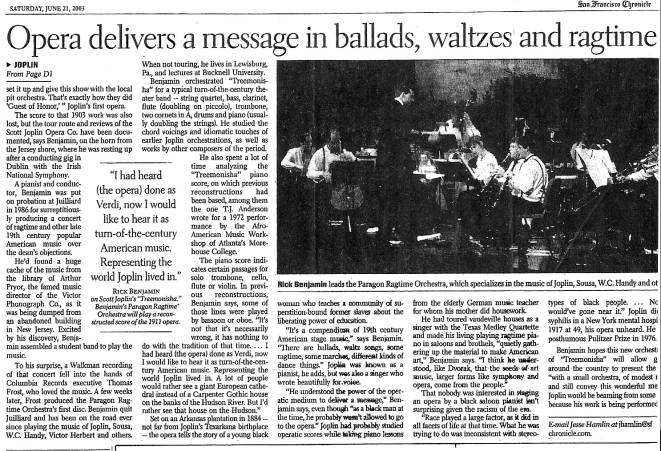
Scott
Joplin opera leaps back to life
Re-creation of ragtime 'Treemonisha' at Stern Grove shows off score's
marvels
Joshua
Kosman, Chronicle Music Critic
Tuesday, June 24, 2003
Ragtime and opera joined hands and
danced together in the most joyous fashion at Stern Grove on Sunday afternoon,
with a vigorous and utterly charming performance of Scott Joplin's "Treemonisha."
The
only large-scale work to survive from the pen of the greatest of the ragtime
composers, "Treemonisha" is still a comparative rarity in performance
for reasons that have as much to do with history -- the piece was never
performed during Joplin's lifetime, and his original orchestrations have been
lost -- as with the opera's intrinsic merits.
Sunday's
semi-staged performance did nothing to conceal the dramatic slightness of the
piece, which was published in 1911. But the score, superbly led by conductor
Rick Benjamin, is a resourceful marvel, a multifarious mixture of
straightforward rags and dances, waltzes, sentimental ballads and full-scale
arias.
Nothing
else Joplin left us suggests a comparable stylistic or expressive range.
Although the score is deeply rooted throughout in the syncopated rhythms,
harmonies and instrumental sonorities of ragtime, he uses those elements to
create set pieces that go far beyond the conventions of the style.
For
this performance, Benjamin, an expert on music of the period, unveiled his new
arrangement of "Treemonisha" for the 11-piece Paragon Ragtime
Orchestra. That lithe, pungent blend of strings, woodwinds and brass -- which
Benjamin claimed was the dominant instrumental sound for American theater bands
from California to Maine -- gave the
performance a lively grace that helped fill the sunny meadow to perfection.
Set
among the impoverished black inhabitants of an Arkansas plantation in 1884,
"Treemonisha" offers an urgent plea for the importance of education in
improving the condition of former slaves.
It
pits the 18-year-old title character, the only member of her community to have
had any schooling, against the conjurers who prey on people's superstitions by
selling them "bags of luck" to ward off evil (although the nature of
their wares is unspecified, one conjurer's reference to himself as the "goofer
dust man" suggests that he is in the same line of work as, say, Sportin'
Life in "Porgy and Bess").
The
dramaturgy is relatively perfunctory -- Act 1 is devoted to exposition, Act 2 to
the conjurers' kidnapping of Treemonisha and Act 3 to her rescue -- and plenty
of time is taken along the way for dances, songs and even a forest ramble in
waltz time for eight scary bears that, sadly, was not staged.
But
Joplin's ingenuity in expanding his palette to dramatic ends is striking, as in
the Act 3 duet for Treemonisha's parents or some of the vocal writing for
Treemonisha herself, which combines operatic phrasing with ragtime melodies.
On
Sunday, the title role was sung with plenty of flair and assurance by soprano
Indira Mahajan, who handled both the high notes and the rhythmic flow of the
role splendidly. Soprano Shalanda Bond and bass-baritone Frank Ward made strong
contributions as Treemonisha's parents.
Tenor
Albert Lee sang sweetly as Remus, the young man who rescues Treemonisha and is
rewarded with the opportunity to preach at length to the community (and the
audience) on the unremarkable proposition that "wrong is never right."
Gene Heard and Courtney Brown were an aptly villainous pair of conjurers, and
the chorus, led by Lynne Morrow, sang skillfully.
The
afternoon began with orchestral versions of three of Joplin's piano rags,
"The Strenuous Life," "Pleasant Moments" and "Elite
Syncopations." These were first-rate renditions, marked by rhythmic
---strength and streamlined elegance.
|
|

Restoration of Scott Joplin's Treemonisha
Receives East Coast Premiere on WFU's Secrest Series
by William Thomas Walker
Wake
Forest University's Secrest Artists Series presented the East Coast premiere of
a new version of Scott Joplin's folk-opera Treemonisha in Wait Chapel
on October 27. In 1896, the composer sought to improve his musical technique and
attended the George R. Smith College for Negroes. Afterward, he began to issue,
with the publisher John Stark, the numerous piano pieces that earned him the
sobriquet "the king of ragtime." Joplin's life-long focus was to elevate to a
par with classical music what had been a largely improvised folk genre. Early
on, he became obsessed with creating a ragtime opera. He moved to New York from
St. Louis in 1907 in order to create and produce his second stage work,
Treemonisha, composed in 1908-11 and orchestrated in 1915, but he was
unable to find backers or a publisher. At his own expense, he published the
piano score and mounted a poorly-received concert performance that used only
piano accompaniment. His original orchestration was lost, and the opera had to
wait until January 28, 1972 for its premiere, in Atlanta. That version used an
orchestration by noted composer T. J. Anderson. Other orchestrations were done
by William Bolcom and Gunther Schuller, and DGG issued a recording of the
latter. These versions call for fairly large forces, similar to the resources
that might be found in traditional European operas.
In
New Grove II (online), Andrew Stiller draws attention to the fact that
"The identification of ragtime as a pop genre and Joplin as a 'minority'
composer has tended to obscure the fact that Treemonisha is the
earliest musically significant opera by an American (apart from Gottshalk's
one-act Escenas Campestres, 1860), and the earliest in an identifiably
modern idiom."
Rick
Benjamin's new orchestration reflects a desire to recreate the work using the
"regulation" twelve-piece theatre orchestra of the period. Rather than "grand
opera," Benjamin sees the work as "an amalgamation of the well-established
American traditions of vaudeville, tap shows, melodramas, and minstrelsy, all
held together by Joplin's marvelous music."
I frankly found the recording of the Schuller version of
Treemonisha rather tame and boring, lacking the snap I remember from his
pioneering ragtime orchestra recordings. Benjamin's
edition wins hands down, communicating rhythmic verve along with a wide palette
of colors and timbres.
Benjamin drew a lively and subtly-balanced performance from his small,
skilled ensemble. A string quartet and a double bass are joined by a flute,
a clarinet, a trombone, two mellow cornets, a piano, and a remarkable battery of
drums and other percussion instruments. Meighan Stoops played her numerous
clarinet solos with marvelous breath control and warm tone. Concertmistress Yuko
Naito and cellist Jane O'Hara had significant solos in different arias that did
much to heighten dramatic impact. Adding considerably to the mix of colors in
the ensemble was Leslie Cullen’s doubling on both flute and piccolo. Trombonist
Gilles Bernard and Kyle Resnick and C.J. Camerieri, cornets, worked wonders as
they played with extraordinary sensitivity, often using very quiet dynamics,
rarely encountered in brasses, producing glowing and mellow blended sound that
was very special. Most fascinating of all were the magical and quiet, subtle
sounds conjured up by percussionist Kerry Meads. He also made a big impact with
a small thunder sheet. All twelve musicians played with extraordinarily tight
ensemble.
Treemonisha is hardly the only opera
that suffers from a weak or tepid libretto. With its conflicts downplayed and
its uplifting moral tone, I could not help but think it would be apt for a
vacation Bible school. I wonder how well it plays outside the Southern Bible
Belt – here, at least, citizens of all races share some common religious
culture....
Found
crying under a tree, a baby girl named Treemonisha was raised by Monisha and
Ned, a childless couple left "in charge" by white owners who had abandoned the
plantation after the Civil War ("The Late Unpleasantness"). The opera opens when
the educated 18-year-old girl comes into conflict with the colorful Zodzetrick,
one of the conjurers who exploit superstitious locals by selling them "Bags of
Luck." The conjurers kidnap Treemonisha and plan to throw her into a wasp's
nest. She is rescued when her student – and love interest – Remus dresses in a
scarecrow's outfit and frightens off the conjurers. The locals capture Zodzerick
and are about to thrash him roundly when Treemonisha intervenes, advocating
forgiveness.
All
the soloists and members of the small chorus had pleasant voices – some were
better, still. There was no lack of strong characterization. The most finished
voice was the bright high soprano of Rita Addico-Cohen, who portrayed
Treemonisha. Her diction was consistently clear and her high notes were on dead
center. Miking of the singers sometimes created a "sonic halo" around
several soloists and may have muddied their lines. AnnMarie Sandy, as Monisha,
has a warm, low mezzo-soprano voice. Baritone Frank Ward, Jr. brought fine comic
timing and an infinite variety of facial expression to the roles of Ned and
Parson Alltalk; there was more than a little of Don Basilio about the latter. As
Remus, Joseph LeBlanc, with a somewhat tight but well-projected tenor voice,
gave a winning performance. Combining the grace of a dancer with a stock
villain's body language, baritone Edward Pleasant was most entertaining as the
conjurer Zodzetrick. Mel LeRoy's solid, well-rounded baritone voice suited the
role of Simon, the chief conjurer. Smaller parts were taken by Trevor B. Smith
(Andy) and Robert Hughes (Cephus); they also sang in the eight-member chorus.
Four
WFU students had roles in the performance: Anna Banerjea created a pleasing
choreography for dancers Joan Pharr, Cara Ray, and Jamie Patterson, who, dressed
in bear suits, swirled about and pirouetted in the ballet, "Frolic of the Bears.
A
variety of slow and fast rags, all delightful, are heard throughout the opera. A
ring dance is a highlight of the episode of the Corn Huskers. "Good Advice,"
which features Parson Alltalk, found the ensemble reacting like a traditionally
lively Black church congregation, with calls and witnessing. The musical
accompaniment is quite at odds with the "goody-good" pabulum that is Joplin's
text. Barber-shop-quartet harmonies, beautifully blended, were prominent in "We
Will Rest Awhile," a personal favorite. My ears suddenly heard a familiar
Viennese rhythm: I had not considered the possibility of a ragtime waltz. At the
end, the entire cast spread across the stage to dance and sing "A Real Slow
Drag," led by Addico-Cohen's glowing voice; she is a most winning Treemonisha.
Richard D. Thompson was responsible for the very effective staging and
choreography of the opera, aside from the "Frolic" dance, and the simple but
functional set was by William P. Muller.
|
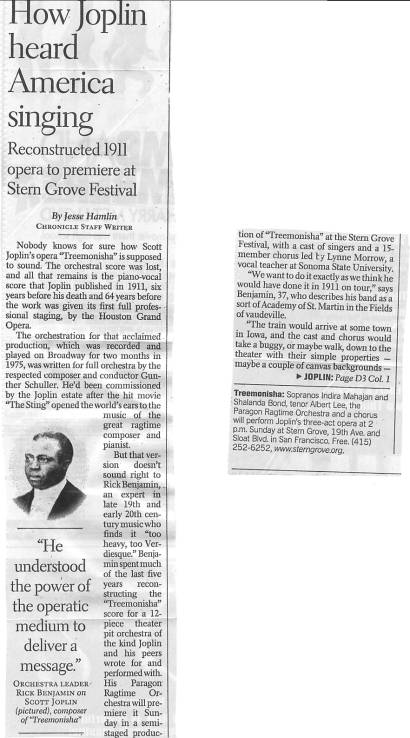
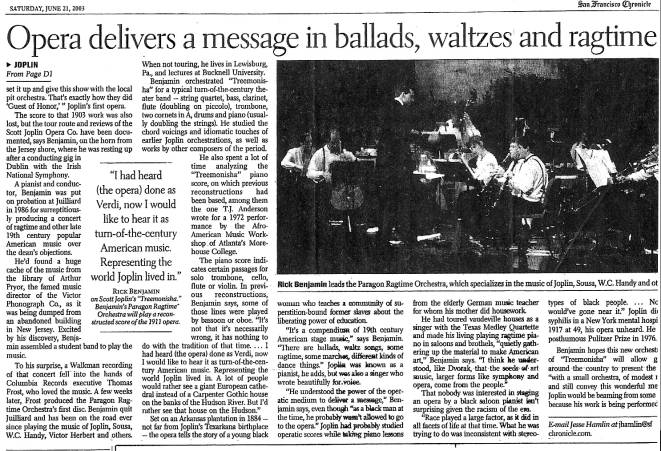
San
Francisco Chronicle preview
click
to enlarge...

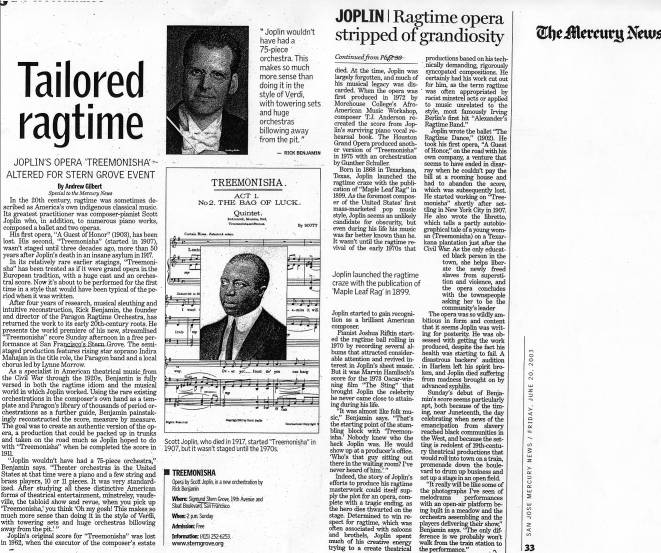
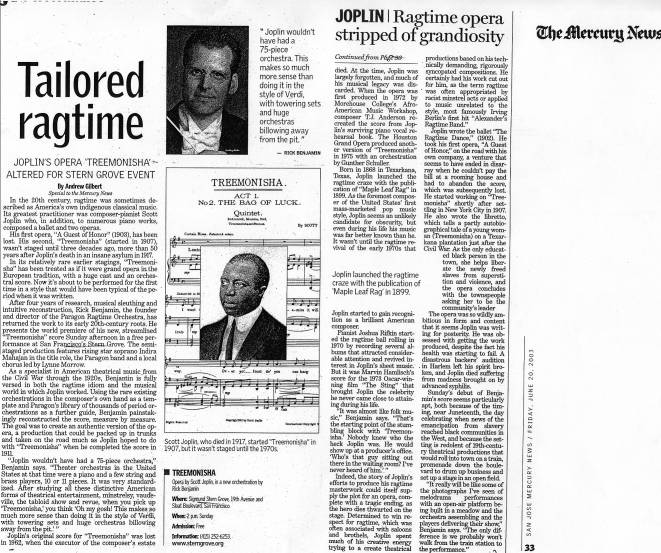
San
Jose Mercury News, preview
Scenes from the Opera
Kris Stone, scenic design
Technical
Requirements
These technical requirements are
preliminary and will be adjusted.
Crew: For load in: 8 person
crew, 12 hours; For running: 8 person, 2 hours; For load out: 8 person, 4
hours
Stage: 40’ x 20’ minimum
Lighting: 125 units
Dressing rooms: 8 dressing
rooms for soloists, 2 choral dressing rooms
|