(1920)
Old Spanish California is the setting in which Douglas
Fairbanks creates the prototype of the modern action-adventure hero, with
surprising humor and athleticism, as “Señor
Zorro.” Slashing his trademark “Z” on the consciousness and
sometimes the posteriors of the corrupt administration of Governor Alvarado,
Zorro leads the way to “Justice for all!”
“You haven’t seen Zorro until you’ve seen Douglas Fairbanks
Sr.… a fine actor, was something else as well: a born action hero, a natural
acrobat and stuntman.”
Steven D.
Greydanus,
Decent Films Guide
Rick Benjamin and his Paragon Orchestra reunite the
Spanish-tinged original score with the cinema classic as they have for 20
years with the films of Chaplin, Keaton and
Harold Lloyd. Mr. Benjamin and his orchestra regularly perform at theaters
great and small throughout North America – from Chattanooga's Tivoli and the
Rialto in Joliet to Lincoln Center and Philadelphia’s Kimmel Center. Mr.
Benjamin also leads silent film programs with orchestras such as the
National Symphony Orchestra of Ireland, the New Jersey Symphony Orchestra
and the Iceland Symphony.
“Theater orchestras…once played in every hotel, vaudeville
hall, and fair-sized restaurant. Few of them can have played with more bite
and sparkle than the Paragon.”
American
Heritage Magazine
“Lisner Auditorium became a
vaudeville movie palace…Listening to a full band perform the complete
scores, written and timed to the action, became a surprising delight…The
audience chuckled along, as much to the music as the films.”
The Washington Post

Scenes From The Film
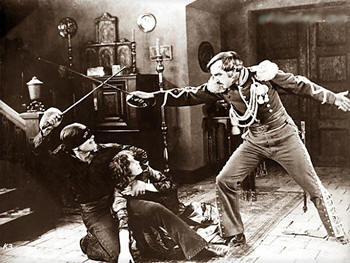
Sword fighting Zorro style –
down on one knee, arm around the girlfriend (Lolita Pulido)
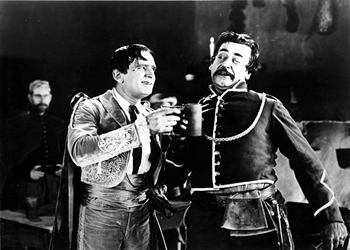
The effete Don Diego (Zorro’s alter ego) humors the
unsuspecting Sergeant Gonzales
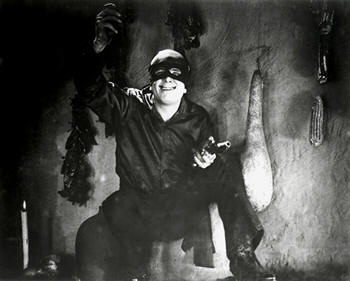
“Let’s see if I can make a ‘Z’ with my pistol – just
kiddingl!”
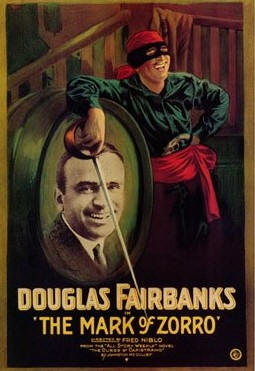
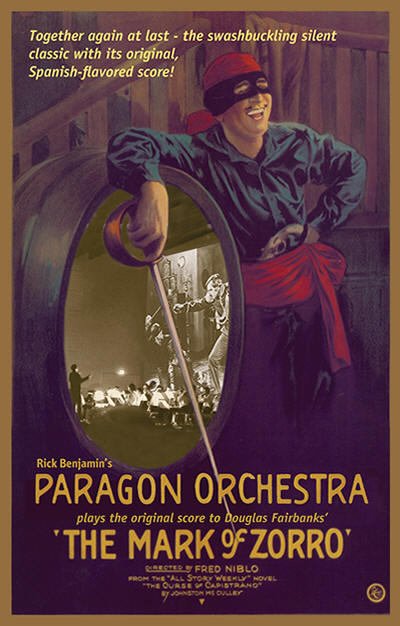
The original poster, which will be adapted for your
presentation.
About The Orchestra
Rick Benjamin and his orchestra have performed the
original scores to silent films for about 20 years. They are the only
orchestra touring with the original scores to the films which they
accompany. And they play these scores with just the instrumentation
intended – the “regulation” theater orchestra of 5 strings, flute, clarinet,
two shepherd’s crook cornets, a vintage small-bore trombone and a 1900’s era
trap drum set with calfskin heads and gut snares. It’s historically
informed without hitting you over the head with it.
The Paragon Orchestra has brought these scores & films to
audiences young and old at the Kimmel Center in Philadelphia, the
Ravinia Festival, to the Washington Performing
Arts Society at Lisner Auditorium, the
Brucknerhaus in Linz,
Austria, and around New York at the Tilles
Center, and Lincoln Center. Rick Benjamin and his crew are frequently
heard in historic theater and movie palaces such as Cleveland's Ohio
Theater, Chattanooga's Tivoli and the Rialto in Atlanta.
Plot Summary
(courtesy
Wikipedia)
The Mark of Zorro tells the story of Don Diego de la Vega,
the outwardly foppish son of a wealthy ranchero Don Alejandro in the old
Spanish California of the early 19th century. Seeing the mistreatment of the
peons by rich landowners and the oppressive colonial government, Don Diego,
who is not as effete as he pretends, has taken the identity of the masked
Robin Hood-like rogue Señor Zorro ("Mr. Fox"),
champion of the people, who appears out of nowhere to protect them from the
corrupt administration of Governor Alvarado, his henchman the villainous
Captain Juan Ramon and the brutish Sergeant Pedro Gonzales. With his sword
flashing and an athletic sense of humor, Zorro scars the faces of evildoers
with his mark, "Z."
When not in the disguise of Zorro, dueling and rescuing
peons, Don Diego courts the beautiful Lolita Pulido
with bad magic tricks and worse manners and she cannot stand him. Lolita is
also courted by Captain Ramon; and by the dashing Zorro, who she likes.
The Mark of Zorro is full of plot twists and secret
passageways. It has an appealing blend of romance, comedy and swordplay, as
Zorro evades pursuit while fighting all oppressors. In the end, when
Lolita's family is jailed, Don Diego throws off his masquerade, whips out
his sword, wins over the soldiers to his side, forces Governor Alvarado to
abdicate, and wins the hand of Lolita, who is delighted to discover that her
effeminate fiancé, Diego, is actually the dashing hero.
Fairbanks' prodigious athletic prowess and tremendous enthusiasm made
the original movie a great success, leading to a whole series of similar
swashbuckler roles for Fairbanks, including The Three Musketeers (1921),
Robin Hood (1922) and The Thief of Bagdad
(1924). A sequel, Don Q, Son of Zorro, with Fairbanks reprising his role as
Don Diego and also playing Don Diego's son, Don Cesar de la Vega, was
released in 1925.
Personal
& Biased Comments About The Attraction
What a modern feel there is to this film! Jackie Chan and
Bruce Willis come to mind as similarly tongue-in-cheek heroes with an
athletic side. Lots of great humor, great swordplay, and with Rick Benjamin
and his band in the pit, it’s a feast for the ears and eyes.
Technical
Requirements
PARAGON ORCHESTRA / ZORRO
Technical Requirements
Click Here for PDF of
Technical Requirements
CONTACTS
For programs & tech
contact Rick Benjamin: Tel (570) 524-9511, Cell (570) 809-0551, and e-mail
[email protected].
For
hotel/hospitality/travel arrangements contact Ms. Leslie Cullen: Tel (570)
524-9511 and e-mail
[email protected].
PRODUCTION SCHEDULE – for a typical 8PM showtime, the orchestra uses the
following schedule. Adapt this according to your starting time. Please have
the appropriate crew available. 2:00 – 4:30PM – Load-in and Setup / 4:30 –
6:30PM – Rehearsal
6:30 – 8:00PM – Break /
8:00 – 10:15PM – Show
10:15 – 11:30PM –
Breakdown
DVD
PROJECTOR & SCREEN - if a film is to be included in program
One high quality
DVD projector suitable for your venue & screen
One large,
high-quality, properly coated, DVD screen placed or hung behind
orchestra. House tech crew should experiment in advance to get image
focused and fully on screen.
INSTRUMENTS, PROPS & FURNITURE
One digital piano, or
spinet or upright piano, tuned to A=440.
Two timpani,. 26" & 29"
Orchestral bells
One rug, approximately
4’ x 6’ to place under drum set.
Eleven straight back
chairs. Wood preferred.
One stool approximately
3’ high (for string bass player).
Sixteen music stands
with stand lights. Old style stands preferred if available.
Two or more large
potted palms or greenery. (optional)
One table in lobby for
sale of recordings.
SOUND SYSTEM
Two microphones to be
used through house system for conductor (wireless system with lavaliere mic
preferred if available).
CD player to be used
through house system during audience seating / intermission (optional).
LIGHTING SYSTEM
Best general stage wash
available.
Two electrical
extension chords (25’) for orchestra stand light hook up to house power.
One follow spot
(optional).
TECH CREW
Projectionist
(experience preferred) if a film is included in program (unless Artist
provides projectionist).
One person familiar
with sound system.
One person familiar
with lighting system and able to run follow spot during performance.
One or more persons to
assist with orchestra load-in and stage set up, break down, etc.
OTHER
A hot meal (menu to be
determined through discussion with orchestra production associate) and soft
drinks/water/coffee backstage for company of 14 during rehearsal and
concert.