|
Almost every mention of Vivaldi
includes the fact that he led an orchestra in an orphanage, and in
this film and program Fabio Biondi opens wide the orphanage doors
and reveals its rich musical life, as told from the viewpoint of the
orphan Chiara, the most famous of the musicians at the Ospedale
della Pieta in Venice. The program features works that Chiara played
at the orphanage and pieces that were composed especially for her.
The combination CD/DVD is available on the Glossa label.
From La Scala in Milan, to Carnegie
Hall and Lincoln Center, to Disney Hall in LA, to Tokyo’s Suntory
Hall, Fabio Biondi and his ensemble are acclaimed for their
revolutionary, passionate performances. Their Four Seasons CD sold
an astounding 500,000 copies worldwide!
newworldclassics.com/galante.htm.
Gramophone writes simply “Europa
Galante are acknowledged as the world’s best.”
Biographies
& Reviews
Biography, Europa Galante
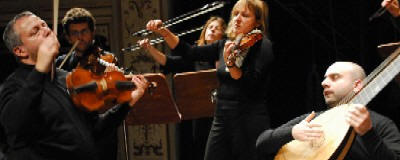
Europa Galante was formed by
Fabio Biondi to draw the international public’s attention to a new and
definitive Italian presence in the interpretation of music from the baroque and
classical eras on original instruments. Biondi gathered around him some of the
best Italian musicians with whom he had already worked, and soon Europa Galante
met with huge success.
Their first record,
Vivaldi’s concertos was awarded the ‘Premio Cini’ of Venice and the ‘Choc dé la
Musique’, and it was soon followed in the subsequent years by a number of
further awards such as five Golden Diapasons, Golden Diapason of the Year in
France, RTL Prize, ‘Record of the Year’ nominations in Spain, Canada, Sweden,
France and Finland, and the ‘Prix du Disque’ (Locatelli’s Concerti Grossi),
‘ffff’ of Telerama review (Alessandro Scarlatti’s oratorio Humanità e Lucifero)..
The ensemble has been nominated twice for the Grammy Awards – in 2004 for its
disc of Vivaldi's Concerti con molti strumenti and in 2006 for its recording of
Vivaldi’s Bajazet. Upcoming recording projects include Vivaldi arias with Vivica
Genaux and a Vivaldi compilation "La Stravaganza ". After the criticially
acclaimed Bajazet, their next opera project is Vivaldi’s Ercole sul Termodonte,
with a very well-known cast: Genaux, di Donato, Damrau, Lehtipuu, Basso. Since
1998 Europa Galante has recorded exclusively with Virgin Classics.
Europa Galante has performed
in many of the world’s major concert halls and theatres: La Scala Theatre in
Milan, the Accademia di Santa Cecilia in Rome, the Suntory Hall of Tokyo, the
Concertgebouw of Amsterdam, the Royal Albert Hall in London, the Musikverein in
Vienna, Lincoln Center in New York and the Sydney Opera House. The ensemble has
toured in Australia, Japan, Canada, Israel, the USA and South America, and often
collaborates with the Ente Santa Cecilia in Rome to recover and restore
eighteenth century Italian operas, such as Antonio Caldara’s La Passione di Gesù
Cristo and Leonardo Leo’s Sant’Elena al Calvario. The ensemble regularly
performs at the Alessandro Scarlatti Festival in Palermo and has given the world
premières of Clori, Dorino e Amore serenata, Massimo Puppieno, Il Trionfo
dell’Onore and La Principessa Fedele.
Europa Galante’s repertoire
ranges from the operas of Handel (Poro) and Vivaldi (Bazajet) and the oratorios
of Alessandro Scarlatti (Maddalena, Humanità e Lucifero, Caino), through to the
great instrumental works of the eighteenth century. The ensemble has a varying
structure, and often performs chamber music such as the string sonatas of
Italian composers of the seventeenth century including Castello, Legrenzi and
Farina.
This season, Europa Galante is performing in Europe extensively, including in
France (Théâtre de la Ville, Theatre des Champs Elysees), Italy (Rome), Spain,
Poland (Krakow Festival), The Netherlands (Amsterdam). In 2010 Europa Galante
will perform in many important halls presenting “the 3 tenors”, a program of
arias with the tenor Ian Bostridge.
Biography, Fabio Biondi
(violin, conductor)
Born in Palermo, Fabio
Biondi began his international career at the age of twelve, performing his first
solo concert with the RAI symphony orchestra. Moved early on by an inexhaustible
cultural curiosity, Fabio Biondi was introduced to pioneers of the new approach
to baroque music, an opportunity that was to expand his musical vision and
change the direction of his career.
When he was sixteen, he was
invited by the Musikverein of Vienna to perform Bach's violin concertos. Since
then, Fabio Biondi has performed with ensembles including Cappella Real, Musica
Antiqua Wien, Seminario Musicale, La Chapelle Royale and Les Musiciens du Louvre
(ever since its foundation) all specialized in the performance of baroque music
using original technique and instruments.
In 1990, Fabio Biondi
founded Europa Galante, an ensemble that, in a few years thanks to their
worldwide concert schedule and extraordinary recording successes, became the
most internationally renowned and awarded Italian ensemble of baroque music.
Fabio Biondi's musical development, oriented towards both the universal
repertoire plus the rediscovering of minor composers, includes three centuries
of music. This is proved by his varied discography: Vivaldi's 'The Four
Seasons', Corelli's Concerti Grossi, the oratorios, the serenatas and operas of
Alessandro Scarlatti (La Messa di Natale, Clori, Dorino e Amore, Massimo
Puppieno and Il trionfo dell'onore) Handel's operas (Poro), and the XVIII
century Italian violin repertoire (Veracini, Vivaldi, Locatelli, Tartini) to
sonatas by Bach, Schubert and Schumann.
Nowadays, Fabio Biondi
embodies the perpetual pursuit of style, free from dogmatism and intent in his
quest for the original language. It is due to this very approach that he can
collaborate as soloist and conductor with many varied orchestras, including
Santa Cecilia in Rome, Rotterdam Chamber Orchestra, the European Baroque
Orchestra, the Opera of Halle, Zurich Chamber Orchestra, the Chamber Orchestra
of Norway, the Orchestre Nationale of Monpellier, the Orchestra Ciudad de
Granada to name but a few.
Fabio Biondi also performs
in duo with piano, harpsichord or forte-piano in prestigious venues around the
world including Cité de la Musique in Paris, Hogi Hall in Tokyo, Auditorium
Nacional in Madrid and Wigmore Hall in London.

Reviews
|

February 12, 2014
Blowing This Way and That
Europa Galante
Brings Vivaldi to Zankel Hall
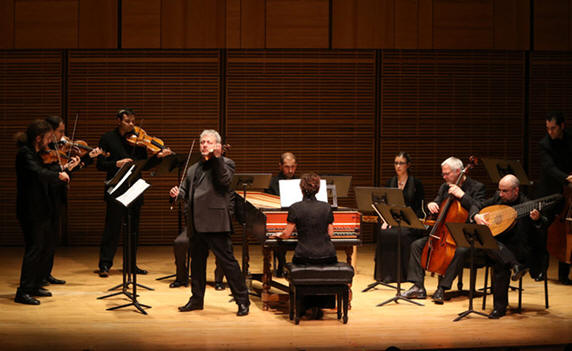
Europa Galante The
violinist Fabio Biondi leading his period-instrument ensemble at Zankel Hall in
a program that interwove movements from Vivaldi sonatas with natural themes.
Michelle V. Agins/The New York Times
Few violin concertos are as
tightly scripted as those making up Vivaldi’s “Four Seasons.” Four sonnets
chronicling the agricultural calendar — possibly by Vivaldi himself — accompany
the music. Their lines are written into the score like stage directions,
instructing the player to evoke the sounds of buzzing gnats on a hot summer day,
hunting calls in autumn or the motion of someone walking gingerly on ice.
Additional labels identify particular kinds of birds — a finch, a cuckoo, a
turtledove — and barking dogs.
Given this meticulous
specificity, it never ceases to amaze and delight me how different this
deservedly popular music sounds from one interpretation to the next. On Tuesday
evening, the zesty Italian period-instrument ensemble
Europa Galante
presented an all-Vivaldi concert at Zankel Hall that included memorably
temperamental renditions of parts of “The Four Seasons.” Led by the group’s
director, Fabio Biondi, who played the principal part in the concertos for
violin, the program offered a collage of works inspired by nature.
Only one of them — the violin
concerto nicknamed “La Caccia” (“The Hunt”) — was played in its entirety. The
opening Allegro from “Spring” was followed by the Cantabile and Allegro from a
flute concerto nicknamed “Il Gardellino” (“The Goldfinch”), played with a
full-bodied, luminous sound by
Marcello Gatti. The
first and third movements of “Summer” framed the Largo and Allegro from “La
Pastorella,” (“The Shepherdess”), a concerto for recorder (here flute), oboe,
violin and bassoon, which featured fine solo playing by the oboist Paolo Grazzi
and the mellow-toned bassoonist Dana Karmon. “Winter” was interspliced with
movements from the violin concerto “La Tempesta di Mare” (“The Storm at Sea”).
The wind-tossed program
proved a perfect fit for Europa Galante. The ensemble’s fresh sound owes much to
its vivid, gusty crescendos, in which the sound seems to gather not only in
volume, but in density, too. On Tuesday evening, those crescendos took shape
as spring showers, August hailstorms and maritime tempests. “Winter” opened with
a jolt, as if someone had kicked open a door to send a blast of icy air into the
auditorium. Sweetly lyrical moments like the slow movement from “La
Pastorella,” in which Mr. Gatti’s lilting solo meshed beautifully with the
tender theorbo playing by Giangiacomo Pinardi, offered welcome respite.
Mr. Biondi’s violin solos
abound with embellishments and sudden changes of tempo that give them an
improvised feel but can sometimes come across as somewhat precious. But there
was a very Baroque flavor to the bracing changes and sudden surprises that
echoed Vivaldi’s seasons, where hail showers interrupt the torpor of a hot
afternoon, and the merriment of harvest revelers contrasts with the terror of
the hunted prey.
Fabio Biondi performs Bach
sonatas with the harpsichordist Kenneth Weiss on Feb. 20 at Weill Recital Hall;
212-247-7800 or www.carnegiehall.org.
|
|
Saturday,
January 23, 2010 Last Update: 9:57 AM ET
Music
Review | Europa Galante
18th-Century
Extroverts and Introverts at Zankel Hall
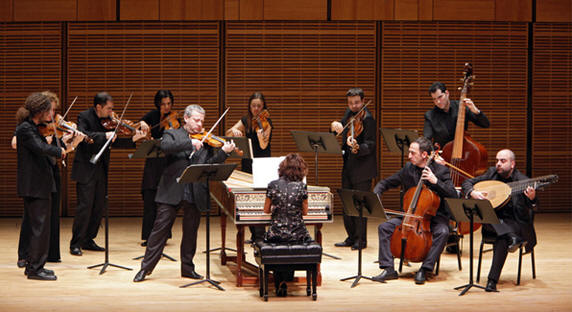
Rachel Papo for The New York Times
Europa Galante, led by violinist Fabio Biondi
(left of center), performing in a program of Telemann, Sammartini, Nardini,
Corelli and Locatelli, at Zankel Hall.
By ALLAN KOZINN
Published: January 22, 2010
Europa Galante, the superb
period-instrument ensemble led by the violinist Fabio Biondi, explored two
distinct sides of the 18th-century orchestral repertory at Zankel Hall on
Thursday evening. The first half of the program was devoted to the extroverted
music of Telemann. After intermission Mr. Biondi and company set their sights on
Italy by way of four strikingly different composers: Sammartini, Nardini,
Corelli and Locatelli.
Like many ensembles of its
kind, Europa Galante performs standing (except for its cellist, harpsichordist
and theorbo player). And though the physical disposition of a band — whether it
is seated or not — usually has little effect on the performance, here the
players often moved in and out of small clusters, depending on the density of
the scoring and the speed of the music. The movement was subtle rather than
choreographed, but it created a sense of interaction that made the
performance particularly vital.
In the broadest and most
superficial terms, a pair of Telemann works may have appeared to represent a
German approach to Baroque style. But not so fast: Telemann was an
outward-looking cosmopolitan composer, and Mr. Biondi undoubtedly chose him
(rather than, say, the more distinctly Germanic Biber) for the breadth of his
influence. The Ouverture à Quatre in F, which opened the program, is steeped in
the influences of the French courtly style, with its stately dotted rhythms,
ornate dance forms and elegant pictorialism. Even so, the work also glanced
further afield, though still through a French prism, in a lively Polonaise.
Telemann’s Concerto for Flute,
Violin, Cello and Strings in A (TWV 53:A2) was another matter. Like Bach’s
concertos, this work is built on an Italian form but uses themes with a more
distinctively German accent. Some of it is boilerplate: the work was composed as
Tafelmusik — music to dine by — and it is meant to entertain without wresting
the attention. Often it captivates despite itself, as in the pastoral Gratioso
movement, with its sweetly melodic flute line, played with a gentle shapeliness
by Frank Theuns.
The Italian works Mr. Biondi
presented ranged widely too, with Sammartini’s dramatic Sinfonia in G (JC 39)
showing the theatrical roots of the symphony, and Nardini’s Violin Concerto in A
(Op. 1, No. 1) taking a conservative view of virtuosity that prizes melodic
subtlety over showiness. Locatelli’s Concerto Grosso in D (Op.1, No. 5) was a
lovely demonstration of textural flexibility and, in its finale, sizzling
ensemble writing.
But the real centerpiece here
was Corelli’s Concerto Grosso in D (Op. 6, No. 4), a zesty attention-grabber
packed with vivid solo passages — even the continuo players had a share of the
spotlight — and a robust full ensemble finale. The group’s sound, unified and
appealingly astringent throughout the concert, had an energy that lifted it off
the stage in the Corelli.
"Extroverts and Introverts of
the 18th Century" The violinist Fabio Biondi and the harpsichordist Paola Poncet
play a recital of Italian works on Feb. 1 at Weill Recital Hall, Carnegie Hall;
(212) 247-7800, carnegiehall.org. |
|

Biondi brings
freshness to 'Four Seasons'
By Alan
G. Artner, Special to the Tribune
January 25, 2010
One of the finest things interpretative
musicians can do is rescue a masterpiece from routine and repetition. Fabio
Biondi and Europa Galante did it Friday night at
Mandel Hall with a work much in need of rescue, Antonio Vivaldi's "The Four
Seasons."
Biondi, an inspired baroque
violinist/conductor and fervent iconoclast, founded
his ensemble 20 years ago, when period-instrument groups started to appear in
Italy. They recorded "The Four Seasons" twice in just over a decade. Part of the
discs' lack of routine came from what they presented, not the published text but
an earlier version differing in many details.
The basis for Friday's performance was that
"Manchester Version." But after playing it for the whole of his group's history,
Biondi said he evolved beyond it. So with characteristic meticulousness, he
prepared his own edition. And with just as much characteristic energy, he dug
into it, displaying iron control and electrifying virtuosity.
The scores' pictorialism — barking dog,
thunderstorm, sleeping drunkards, icy rain — emerged vividly. Yet, despite
affection for detail and more expressive tone than many period-instrument groups
create, the shapeliness of each concerto was maintained. No episode relaxed into
hazy mood painting. Color and fantasy were tightly held on a rein that allowed
exhilaration but not forced sound or overstatement. It was an ideal balance.
The last time here, at Ravinia in 2001, the
12-member ensemble had a countertenor as star performer. This time there were
three imaginative instrumentalists: Biondi, baroque flutist Frank Theuns, and
the group's cellist, Maurizio Naddeo. They came together in the famous A-major
Concerto from Georg Philipp Telemann's ambitious collection called "Banquet
Music."
Everyone showed a grace that recognized such
rococo characteristics as refined textures, ingratiating ornaments and lightly
sprung rhythms. Italian fire was, of course, turned down. But both the concerto
and Telemann's plusher, lesser-known Ouverture a quatre in F still had a
keenness of response that enlivened rich, tapestry-like color and cosmopolitan
expression.
There were two encores: The allegro finale from
Arcangelo Corelli's Concerto Grosso, Op. 6, No. 4, played with lean brilliance;
and the pizzicato movement of Christoph Willibald Gluck's ballet pantomime, "Don
Juan," which was all delicacy consummately shaded into silence.
Copyright © 2010,
Chicago Tribune |

Italian violinist Fabio
Biondi's Baroque ensemble shines at Disney Hall.
By Chris Pasles, Los Angeles
Times Staff Writer April 3, 2008
Whatever is happening to
global weather patterns, there's definitely been a climate change in the
performance of Baroque music since the stranglehold of historical performance
practice began tightening in the 1970s. The atmosphere is more temperate now.
Laws have relaxed. Variety is encouraged. The regional differences that existed
in the period itself are mirrored in different approaches by groups from a
variety of cities and countries. Italian violinist Fabio Biondi founded his
period instrument group,
Europa Galante, in 1990 to assert his country's presence on this
international scene. The results have grown increasingly prominent and welcome
at festivals and concerts around the world. The group has a special reputation
for resurrecting 18th century Italian operas, and its recording of Vivaldi's "Bajazet"
was nominated for a Grammy in 2006.
Tuesday night, Biondi brought the 11-member ensemble to Walt Disney Concert Hall
for a program called "France, Italy and England -- Connections and Exchange,"
which included concertos by Vivaldi and Leclair, a suite by Purcell and a suite
of Biondi's own devising drawing on the music of six composers.
The playing that ensued was
inviting, energetic, tightly cohesive and transparent in texture.
It adhered to the general historically informed approach regarding short
phrasings and sparing use of vibrato, but it was more liberal in its shifting
dynamics.
Although not as personally expressive as some Baroque violinists (the San
Francisco-based Philharmonia Baroque's Elizabeth Blumenstock comes to mind),
Biondi wore
his considerable virtuosity and authority lightly, with no grandstanding.
Like all the musicians, except for the cellist, harpsichordist and theorbo, or
lute, player, he stood when he played. Vivaldi was represented by three pieces:
the Sinfonia to the serenata "La Senna Festeggiante," the Concerto in D minor
for viola d'amore and lute, RV 540, and the Concerto in D minor for two violins,
cello and strings, Opus 3, No. 11. The last, from the influential collection "L'Estro
Armonico," is one of the works Bach transcribed for keyboard as he studied the
Italian master's music.
All three works gave evidence of that amazing quality of unpredictable melodic,
harmonic and rhythmic invention in seemingly straitjacketed forms that has
beguiled audiences for three centuries. Short fanfares and trotting rhythms
opened the Sinfonia, taken from an obsequious 1726 Venetian ceremony honoring
the French King Louis XV -- although unexpected chromatic slithering surfaced in
the slow middle movement.
Giangiacomo Pinardi was Biondi's valuable partner in the soft-toned concerto for
viola d'amore and lute. In the sometimes weird duo-violin concerto, Andrea
Rognoni matched Biondi perfectly in imitative passages and stood by patiently
whenever Biondi got the lion's share of the limelight, which was more often than
might have been expected. Maurizio Naddeo was the exceedingly capable cellist,
Salvatore Carchiolo the harpsichordist.
Not surprisingly, Purcell's nine-movement Suite from Aphra Benn's bloody-minded
play "Abdelazer, or the Moor's Revenge" was more dour and dramatic than any of
the Vivaldi pieces. But Leclair's Violin Concerto in C, Opus 7, No. 3, which
followed, restored a sense of ease and good humor to the program.
Biondi's concluding suite, "Les Nations," consisted of movements by Baldassare
Galuppi, Georg Muffat, André Campra, Georg Philipp Telemann, Heinrich Biber and
André Cardinal Destouches. Each piece was originally composed in a style
considered foreign or exotic, but those distinctions seem only quaint now, even
as some of the composers have faded into obscurity. All were worthy, with
Destouches' closing Chaconne especially gracious and delightful.
The encore was the Pizzicato from Gluck's "Don Juan." |

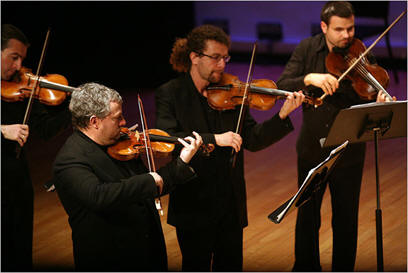
Michael Falco for The New York
Times
Fabio Biondi, second from
left, led Europa Galante at the Miller Theater in the last concert in the series
“Bach and the Baroque.”
April 14, 2008 Music Review |
Europa Galante
By
BERNARD HOLLAND
World Tour, in a Baroque
Sort of Way
Baroque music practiced its
own kind of globalism in its time, although the globe was smaller then. Bach
wrote French and English suites and an “Italian Concerto.” Domenico Scarlatti
wrote in a style nurtured in Italy but with the twang and rhythmic snap of a
Spanish guitar. The fascination that turn-of-the-18th-century Europe felt for
the faraway extended to barbarians (“Les Barbares” by Biber) and China (“Les
Chinois” by André Campra), both pieces heard in Europa Galante’s concert at the
Miller Theater on Saturday evening, the last of four in a series called “Bach
and the Baroque.” The 10-member string band, directed by Fabio Biondi, offered
music by Italians, British, French and Germans, all thinking about places other
than their own. There were various concertos by Vivaldi, one by Jean-Marie
Leclair and a suite from Purcell’s “Abdelazer (The Moor’s Revenge).”
At the end Mr. Biondi
assembled an international conference in eight movements called “Les Nations,”
with references to Spain, France, Italy, Denmark, Britain, China and, again,
those barbarians. The participating composers were Galuppi, Muffat, Campra,
Telemann and Biber. A handsome Chaconne by André Cardinal Destouches served as a
finale. Some of the exchanges of information between composer and country were
firsthand. Vivaldi traveled north to Central Europe. Telemann’s movements were
more east and west. Bach never went much of anywhere but devoured the Vivaldi
scores that came his way. Until fairly recently, works thought to be Bach’s were
really Vivaldi pieces copied out in Bach’s hand.
Distinguishing nationalistic
tendencies at Saturday’s concert required paying attention to formats, and also
to the power of suggestion. The slow introduction in dotted rhythms by Galuppi
(a Venetian) displayed a Frenchness that was later a hallmark for the symphonies
of Haydn (an Austrian). Campra’s Chinese music, on the other hand, was about as
Chinese as chop suey. Biber’s barbarisms were unmistakable: violent accents,
lopsided movement and a sudden ending. The nine Purcell movements here were
completely civil and filled with life; if exoticisms were intended, jaded modern
ears had to take them on faith.
Mr. Biondi, busy everywhere as
a violinist, also joined Giangiacomo Pinardi in Vivaldi’s D minor Concerto for
viola d’amore and lute. Other principals in this good group were Andrea Rognoni,
violinist, and Maurizio Naddeo, cellist. |
|

October 25, 2005
Music Review | Europa Galante
A
Violinist's Spry Spins on Mozart And Vivaldi
By
ANNE MIDGETTE
You
could say it was a concert about Vivaldi, whose music was supposed to begin and
end it. You could say it was a concert about narrative music, since the revised
program order began with Telemann's tongue-in-cheek musical accounting of that
great tongue-in-cheek novel "Don Quixote" and culminated in Vivaldi's
illustrative "Four Seasons."
Or
you could say that the concert - given by the ensemble Europa Galante on Sunday
afternoon at Alice Tully Hall - was about Fabio Biondi, the violinist who
founded the group and serves as its conductor, concertmaster and soloist. In the
first half, which included the 11th symphony by
Mozart, then 14 years old, and Vivaldi's overture to the pasticcio opera "Il
Tamerlano" (also called "Il Bajazet"), as well as Telemann's "Burlesque de
Quixotte," he played with his back half to the audience, actively fostering a
spicy ensemble sound that mingled crisp delivery and animation with the
throatiness of period instruments.
Then,
for "The Four Seasons," he turned around for his solos to face the audience for
the first time, and there was the sense of a dramatic unveiling of a musician
who, from the first birdsongs of "Spring," was at once puckish and virtuosic.
The
implicit but unspoken drama of that unveiling was characteristic of an event
where the strengths lay in small touches, bright thoughts and an easy vigor, all
offered with an understatement born of complete confidence. Mr. Biondi did not
always even play cleanly, and there were moments - the adagio of "Summer," for
instance - when the music seemed to lose steam. But the afternoon's hallmark was
a kind of expressive vitality that held back enough to let the music speak for
itself.
Some
ensembles, in reanimating old music, push it to the brink of violence. In this
performance, by contrast, the ends of movements often closed with surprising
paleness, as if the music had naturally run its course - or as if Mr. Biondi's
active mind had already moved on to the next topic.
|
|
www.SanDiego-online.com
10/16/2005 Review by Christian Hertzog
Europa Galante (Fabio Biondi,last row,
3rd from left)
An early music concert can have its benefits and its drawbacks. On the one hand,
we get to hear infrequently performed music. On the other hand, we have to
listen to infrequently performed music.
Such
was the case with
Europa Galante, led by the terrific violinist, Fabio Biondi. When local or
visiting orchestras play Baroque music, it's usually drawn from the same two
dozen or so pieces: Bach orchestral suites or concerti, Vivaldi's Four
Seasons, Handel's Water Music, etc. In its Sunday evening concert
at Sherwood Auditorium, Europa Galante eschewed the obvious, opting for an
enlightening evening of 18th-century orchestral music.
The
standard Baroque orchestra of the time consisted of strings with a continuo. The
continuo, the Baroque equivalent of the jazz rhythm section, could consist of
any instrument capable of playing harmonies (harpsichord, organ, lutes), usually
supplemented with a bass instrument (gamba, cello, even bassoon). Europa Galante
assigned the continuo part to a combination of cello, violone (the predecessor
to the contrabass), harpsichord, and theorbo (a large lute, whose size suits it
better for ensemble playing).
Twenty years ago, hearing string ensembles play with little or no vibrato was a
novelty. Today, are there any classical music listeners who have not encountered
period ensemble performances of Baroque music?
As
you might expect from an orchestra booked by the
San Diego Early Music Society, Europa Galante interprets Baroque music using
"authentic" performance practices. Since we have no recordings from the time,
and expressive marks were minimal, if at all present, there is tremendous
leeway, and sometimes rancorous debate, in what constitutes an authentic
performance. For instance, how fast is an Allegro? How slow is a Largo? How much
embellishment and ornamentation is appropriate? What kind of tone should the
strings produce?
Some practitioners (think of Roger Norrington with his Beethoven
symphonies) take an openly confrontational stance, resulting in radical new
interpretations. Europa Galante takes a middle-of-the road approach. Their
performance aesthetic is not an end in itself. Sure, there's the by-now-standard
vibrato-less playing in the strings, and they do this extremely well. If there
was one turn-off above all others in the 1970s-80s in early music recordings, it
was the bad intonation. Europa Galante rarely hit sour notes, producing
bold, clear fortes, beautiful pianissimos, and crisp ensemble
work.
The
harpsichordist (Paola Poncet) and theorbo player (Giangiacomo Pinardi) produced
inventive, but never distracting, accompaniments, sweet melodies and chordal
figurations of their own creation. This was most noticeable at the end of the
Adagio in Corelli's Concerto Grosso in D, op. 6, no. 4. Many Baroque slow
movement end with a series of three or four chords, each one held in unison
rhythm. Here, the chords were drawn out, while the theorbo and harpsichord spun
out delightful little cadenzas.
The
program began with Telemann's Burlesque de Quixotte, an orchestral
dance suite doubling as program music in which various scenes from Don Quixote
are depicted. This was followed by Geminiani's Concerto Grosso in D Minor, a set
of variations on the folia (a bass pattern from the Renaissance that, in its
continuous reuse by composers, became the classical equivalent of 12-bar blues).
Like Telemann, Geminiani's variations take on another aspect--in their grouping
of fast, slow, and then fast variations, they mimic a traditional three-movement
form.
It
was in Geminiani's Concerto Grosso that Fabio Biondi first gave us a taste of
his virtuosity, in variations which featured furious solo violin passagework. In
one of these, two distinct lines emerged as Geminiani set up a call and response
with rapid passagework alternating between the upper and lower strings of
Biondi's violin.
Next,
in the Violin Concerto by Vivaldi (op. 3, no. 9 in D major), Biondi further
revealed his keen musicianship in clean cascades of breakneck scales and
arpeggios in the outer movements, and a warm, lyrical solo in the inner. The
continuo (which included the lower strings) dropped out in this Larghetto,
leaving only the gentle yet relentless pulsing of the violins and violas to
discreetly accompany Biondi.
Biondi's stage demeanor is fairly low key; the disparity between
the torrents of notes flying off his instrument and his poker face was a
refreshing change of pace to the emotional mugging of many violin soloists.
His fingers zipped across the violin strings and his
bowing arm was a blur, all the while as he calmly gazed at his music stand.
The same high standards of solo and orchestral performance prevailed in the
second half, which consisted of Sammartini's Sinfonia in F major, JC 38,
Vivaldi's Violin Concerto in D minor, op. 8, no. 9, and Corelli's Concerto
Grosso in D major, op. 6, no. 4.
It
was nice to hear this repertory, rare as it is in San Diego. But the old jokes
about every Baroque concerto sounding the same began to surface by intermission.
While it was educational, and even pleasant to hear Sammartini and Geminiani,
well--did we really need to hear them? Part of the sonic fatigue, such as it
was, may have been due to the key relationships: at least 4 pieces in D major or
minor, and another in F major (which has the same key signature as D minor).
In the grand scheme of things, the excellence of the performances
and the novelty of the repertory (for San Diegans, anyway) ultimately prevailed.
The audience loudly called Europa Galante back on the stage three times, until
they finally played an encore, a charming unidentified piece played entirely
pizzicato, which they miraculously faded out to practically nothing.
As I
left the hall, I couldn't help noticing that I'd heard an Italian orchestra play
practically nothing but Italian composers, and the week before, a Mexican
orchestra play Mexican composers (with one Cuban composer). Is it too much to
hope to hear in San Diego, in the not too distant future, an American orchestra
playing a concert of American music?
Click
here for program.
|
|
August 9, 2003
MOSTLY MOZART FESTIVAL REVIEW
A
Scarlatti Premiere, but for the Father
By
ANTHONY TOMMASINI
A generation ago when you mentioned
Scarlatti, everyone assumed you were talking about Domenico Scarlatti, the
18th-century composer of some 550 single-movement keyboard sonatas, wondrously
inventive works that were championed by Vladimir Horowitz and that turned up on
recitals by conservatory pianists everywhere. And Alessandro Scarlatti? Oh yeah,
he was that forgotten Baroque composer who was Domenico's father.
Actually,
in his day the elder Scarlatti, born in 1660, was widely hailed for his operas
and oratorios. The operas are still mostly unknown except to connoisseurs. But
if the Italian conductor and violinist Fabio Biondi has his way, the Scarlatti
oratorios are going to enter the repertory.
Mr.
Biondi has been taking Europa Galante, his dazzling early music ensemble,
on a European and American tour to present Scarlatti's "Oratorio per la
Santissima Trinità," composed in 1715. The tour arrived at the Mostly
Mozart Festival on Thursday night to present the United States premiere of the
oratorio at Alice Tully Hall before a nearly sold-out house. Europa
Galante is well known from its recording of Vivaldi's "Four Seasons,"
which has sold half a million copies.
From
the vibrant, crackling and assured
performance on Thursday, you could sense how much Mr. Biondi and his
troupe believe in this work. Historians used to view Alessandro Scarlatti as a
tradition-bound figure whose music was brushed aside by the innovations of Bach
and Handel a generation later. But "La Santissima Trinità" is a
beguiling and refined work that puts a surprisingly wry spin on a staid
allegorical libretto of unknown authorship.
Scored
for five vocal soloists and an ensemble of strings and continuo keyboards, the
oratorio depicts a heated debate among five characters — Faith, Divine Love,
Theology, Infidelity and Time — over the nature of the Holy Trinity. This
sounds like a dogmatic tract for the religious edification of the general
public. But some recent scholarship suggests that oratorios like this were
intended not as church music but as entertainments for the privileged.
"La
Santissima Trinità" is rich with vividly operatic characterizations,
instrument writing that offers solo strings ample chances to mingle with the
virtuosic vocal solos, and a sophisticated musical harmonic language that keeps
you on guard with its sly harmonic shifts.
But
it is Scarlatti's droll attitude toward the allegorical characters that makes
the work seem an entertainment. The bad guy in the story is Infidelity (the
tenor Enrico Onofri), who in sputtering recitatives and sneering arias debunks
the idea that three entities can reside in a single deity. Faith (the soprano
Marta Almajano) tries to persuade Infidelity with music of sweet lyricism as
well as flights of coloratura that indicate how much this alarming doubter
flusters her. Faith is more grounded when paired in duets with Theology (the
contralto Sonia Prina), a worldly figure who understands how much a leap the
concept of the Trinity can seem.
Intervening
in the argument is Divine Love (the mezzo-soprano Laura Polverelli), who in
gusty vocal lines touched with a bit a smugness tries to explain the mystery
from her exalted vantage point. Meanwhile, Time (the bass Roberto Abbondanza)
treats Infidelity as another typical young kid who will come around in, well,
time. Only toward the end, when Infidelity is still resisting, does Time break
out in exasperated arias.
When
the recalcitrant Infidelity finally acknowledges his error, this joyous oratorio
ends not with a celebratory chorale but with Faith professing her pleasure in
phrases of quiet satisfaction that just slip away over the concluding soft,
pizzicato chords of the orchestra. The audience's ovation was so enthusiastic
that Mr. Biondi and his ensemble repeated the charming finale of this
inexplicably neglected work.
|
NY
TIMES CD REVIEW (click to enlarge)

EUROPA
GALANTE TELEGRAPH REVIEW (click to enlarge)
EUROPA
GALANTE TIME OUT REVIEW (click to enlarge)

|
CLASSICS
TODAY
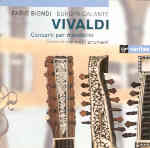
ANTONIO VIVALDI
Concertos for mandolin, and for multiple instruments RV 555, 558, 532, 576, 564,
319, 425
Europa Galante
Fabio Biondi
Virgin Classics- 45527 2(CD)
Reference Recording - None for this coupling

This
delicious collection contains two of Vivaldi's most remarkable creations, the
Concertos RV 555 and RV 558, scored or vast ensemble including solo mandolins,
recorders, oboes, chalumeaux, cellos, harpsichords, theorbos, viole ll'inglese,
and something called "violini in tromba marina", which no one to this
day is entirely sure about. And my, how Fabio Biondi and Europa Galante do play!
At first the tempos sound excessively fleet, but when you hear how well these
layers handle their solo episodes, and sense their joy in the excesses of
Baroque instrumental writing and the opportunities for virtuosity that it
offers, then it's practically impossible not to be swept away in the sheer
excitement of it all. That said, if ou love this music you also should hear
Leonard Bernstein's wonderful performance (on Sony) of Alfredo Casella's edition
of RV 558, rescored for an equally extravagant ensemble of modern instruments.
The
heart of this collection lies in the three concertos featuring solo mandolin (RV
532 actually requires two), which number among Vivaldi's most piquantly
appealing inspirations. RV 576, scored for solo violin, two recorders, three
oboes, and solo bassoon, also represents the composer at his most inventive and
expansive, and the quality of the wind playing here is second to none in the
period instrument world. In short, you will find in these performances more than
sufficient evidence to refute the notion that Vivaldi wrote the same concerto
600 times. Or at all events, he only did it 593 times: these seven works remain
outstanding for their character and individuality, and you won't find them
better played or more immaculately recorded anywhere.
--David
Hurwitz
|
Programs
“Chiara’s Diary - A life at the
Ospedale della Pietà in Venice” FILM & CONCERT PROGRAM
Almost every mention of Vivaldi
includes the fact that he led an orchestra in an orphanage, and
in this film and program Fabio Biondi opens wide the orphanage
doors and reveals its rich musical life, as told from the
viewpoint of the orphan Chiara, the most famous of the musicians
at the Ospedale della Pieta in Venice. The program features
works that Chiara played at the orphanage and pieces that were
composed especially for her. The combination CD/DVD is available
on the Glossa label.
Giovanni Porta Sinfonia in
D Major
Antonio Vivaldi Sinfonia for Strings in G Major “il Coro
delle muse”
Nicolo Porpora Sinfonia a tre Op. 2, No. 1
Antonio Martinelli Violin Concerto in E Major “dedicated
to Senorita Chiara”
Antonio Vivaldi Concerto for Viola D’amore and Lute in D
Minor
Antonio Martinelli Concerto for Viola D’amore in D Major
“for Senorita Chiaretta” (original cadenzas composed by Chiara)
Andrea Bernasconi Sinfonia in D Major for Strings
Fulgenso Perotti Grave in G Minor for Violin (original
cadenza composed by Chiara)
Andrea Bernasconi (segue sinfonia)
Gaetano Latilla Sinfonia in G Major (1761)
Discography
click
here
Personal & Biased Comments About the Artist
As I made the 110-mile drive down the Merritt
Parkway for Europa Galante’s Mostly Mozart performance of Scarlatti’s “La
Santissima Trinita,” I thought, “I must really want to hear these
people!” I dreaded a night of 2nd tier Baroque composition, but EG’s exciting
recordings had caught my ear (and millions of other ears, too). I arrived hoping
for the best but fearing… and they absolutely pulled it off! (see the
review above, NY Times August 2003) It starts with Biondi’s alert but somehow
relaxed direction as he plays the violin. On that night, he wandered about the
stage, nodding cues to his colleagues (instrumental & vocal) as he played. His
spirit informs it all – there’s an appealing humanity that you can hear in every
phrase of the Europa Galante’s music-making.
Technical Requirements
Chairs & stands as needed, probably a baroque
pitched harpsichord and/or organ, dressing rooms, light refreshments during
rehearsal & concert. More to be determined.
|